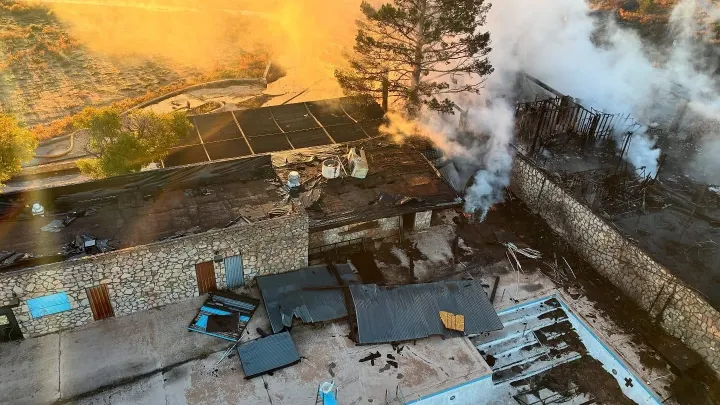
Why does Las Cruces need $1.1 million to repair Amador Live?
Why does seven-year-old Amador Live need $1.1 million in repairs? City records reveal deterioration, unfinished construction and oversight failures.

City records detail deteriorating deck waterproofing, unfinished construction and extensive proposed renovations at the seven-year-old entertainment complex as an internal audit documents financial and oversight failures.
Damien Willis, Organ Mountain News
LAS CRUCES - Seven years after Amador Live opened as a centerpiece of downtown redevelopment, the City of Las Cruces is considering $1.1 million in repairs to an entertainment complex that has been largely inactive for nearly two years.
The proposed work includes reconstruction of a second-floor deck, replacement of doors, flooring, windows and cabinetry, repairs to exterior walls and completion of an unfinished service area that was part of the building's original design.
Records released Nov. 12 in response to an Inspection of Public Records Act request filed by Organ Mountain News provide a detailed look at the property's construction, maintenance history and proposed rehabilitation. A separate internal city audit, issued in February, documents extensive deficiencies in the financial management and oversight of the original development and its private operating arrangement.
Together, the records raise a central question: Why does a relatively new, publicly funded entertainment complex need such extensive work?
The documents establish specific areas of deterioration and unfinished construction, but they do not demonstrate that the entire repair bill resulted from defects in the original work. Nor does the city's audit establish that shortcomings in financial oversight caused the building's physical problems.

Where the $1.1 million would go
During an Oct. 26 City Council work session, Public Works Director David Sedillo presented an estimated $1.1 million in repairs intended to restore Amador Live to usable condition.
The itemized estimate provided to OMN assigns $257,418 to reconstruction of the second-floor deck. The proposed work includes removing the existing concrete deck surface, replacing damaged wood as needed and rebuilding the assembly with a rubberized waterproofing system.
Another $224,187 is allocated to removing and replacing cabinetry and other casework, while $154,370 would go toward new epoxy flooring and baseboards in the main restaurant and two enclosed entry patios.
Other proposed expenditures include $88,970 for second-floor stucco repairs, $45,000 for interior wall repairs and painting, $26,870 for window replacements and $26,605 for masonry and rock wall repairs.
Exterior and interior door replacements on both floors account for another $139,180.
The estimate also includes $16,000 for electrical, plumbing and related repairs, including damaged fixtures and outlets and a leaking backflow preventer identified in the document.
The individual line items total $1.1 million.
The estimate does not provide a separate breakdown identifying how much of that amount addresses original construction deficiencies, later deterioration, routine maintenance or improvements intended for future uses.
At the October work session, Sedillo described a combination of unfinished work, deferred maintenance and building-code concerns. He also said some exterior doors appeared to have been installed to residential rather than commercial standards.
Those observations do not, by themselves, establish that the original contractor violated building codes.
The council did not authorize the $1.1 million expenditure during the work session. City staff proposed using downtown Tax Increment Development District revenue as a possible funding source, subject to appropriate approvals.
Deck problems documented in 2025
A commercial appraisal prepared by Brooks Real Estate Services in March 2025 provides an earlier assessment of Amador Live's condition.
The appraiser described the building's overall condition as average relative to its age, while identifying specific items of physical deterioration and unfinished improvements.
Among the most notable observations were separated seams in the waterproof covering on the second-floor customer deck.
The appraisal estimated $16,300 for repairs to the deck covering and related painting and patching, including contingency and coordination costs.
An April 29, 2025, construction proposal from Nine Degrees Construction identified a substantially more extensive deck project, priced at $257,418.
Rather than repairing only the waterproof covering, the contractor proposed demolishing the concrete deck surface down to the wood substrate, replacing damaged wood where necessary and rebuilding the deck to the original construction detail.
The estimates reflect different scopes of work. The documents do not establish whether the earlier, more limited repairs would have been sufficient or why the larger reconstruction was proposed.
The $257,418 deck figure subsequently appeared unchanged in the city's $1.1 million repair estimate.
The April 2025 proposal offered to perform a broader package of work for $818,663 plus gross receipts tax. The proposal also contemplated a construction period of 140 working days after issuance of a building permit, delivery of materials and formal notice to proceed.
The proposal is evidence of contemplated work and pricing, not proof that the city authorized or completed the project.
An unfinished part of the original design
The appraisal identified another issue unrelated to ordinary wear and tear.
The second-floor waiter station and food-service area remained unfinished, including interior wall finishes and a planned dumbwaiter connecting the ground-floor kitchen to the upper level.
The appraiser estimated $12,500 to complete those improvements.
The city's subsequent repair estimate includes the same $12,500 amount for the dumbwaiter buildout, referencing the appraisal.
Unlike damaged flooring or weather-exposed surfaces, that expenditure concerns work the appraiser identified as unfinished from the original development.
The city's construction records also contain design changes made before and during the project.
An October 2017 architectural addendum formally eliminated a proposed coffee shop building, replacing its footprint with a paved patio serving the Tap Room. Other revisions altered upper-level porches, structural details, windows and stairs.
Those documents help distinguish authorized design changes from portions of the project that remained incomplete.
The absence of an element shown on an early architectural drawing does not necessarily establish defective or unfinished construction if subsequent revisions formally removed it.
Maintenance problems after closure
The city's more recent facilities records document additional maintenance needs at Amador Live.
An August 2026 work order requested an inspection of exit signs and emergency lighting. A subsequent maintenance note reported that 10 lights were not working and that 12 replacement units had been ordered.
The work order remained listed as in progress when the report was generated Oct. 30. The document does not establish whether the replacements were subsequently installed.
A separate work order created Sept. 23 reported water leaks at Amador Live following heavy rain.
That request was listed as approved, but the record did not document completed roof repairs.
At the same time, the city's inspection records do not show universal failure of the property's safety systems.
An Aug. 12, 2026, Las Cruces Fire Department annual inspection recorded a passing result, while noting that sprinkler gauges needed replacement and a five-year sprinkler inspection was scheduled.
The maintenance records document problems requiring attention. They do not establish when each condition originated or whether it resulted from original construction, subsequent deterioration or other causes.

An audit identifies broader oversight failures
The physical condition of Amador Live is only one part of the property's history.
A 78-page report issued Feb. 18, 2026, by the city's Internal Audit Office identified significant deficiencies involving the original Amador Project and its lease with Amador Hospitality LLC, the former private operator.
The audit examined the lease agreement and related activities from June 2018 through Jan. 31, 2025. Its scope was expanded to include a limited review of the project's funding and compliance with municipal procurement requirements.
Auditors concluded that construction of new improvements on city-owned property, as part of the approximately $6.5 million Tax Increment Development District-funded project, did not follow the competitive procurement procedures required by city ordinance.
They reported finding no evidence that the construction contractor was selected through competitive bidding, a request for proposals or another documented procurement procedure.
The auditors said anticompetitive practices may have occurred. The report did not establish that such practices actually took place.
In its written response, the city's Legal Department generally agreed with the procurement finding and acknowledged the need to comply with applicable purchasing requirements.
The audit separately identified deficiencies involving lease enforcement, accounting, licensing oversight and financial controls.
As of Jan. 31, 2025, auditors estimated $406,042.63 in outstanding rent and related fees, including unpaid lease payments, late fees, parking charges, utility obligations and licensing balances.
They also identified approximately $1.22 million in maximum potential future lease revenue, subject to the city's obligation to mitigate losses.
That additional amount was not an established outstanding bill, and the records examined for this report do not establish how much of the historical obligations has since been recovered or adjusted.
Auditors also found that $118,513.43 in payments received from Amador Hospitality had not been applied to outstanding lease invoices, contributing to inaccurate account statements.
Another finding concerned a $2,297,565.37 wire transfer for the Amador Project made before the customary authorization paperwork was completed. The authorization was subsequently documented.
Those findings concern financial management and administrative oversight. The audit did not determine whether the city's procurement or lease-management practices contributed to the building's physical repair needs.
City acknowledges need for changes
The audit includes written responses from city management and the Legal Department.
The Legal Department attributed many of the project's shortcomings to insufficient institutional knowledge about Tax Increment Development District-funded projects. It noted that the department directors serving during the audit were not the same officials who held those positions when the activities under review occurred.
The department acknowledged the need for policy changes and reported that Finance and Utilities had already begun corrective measures.
City management also expressed support for implementing the audit's recommendations.
Those statements document the city's response to the audit. The records reviewed do not independently establish the implementation status of every recommendation as of November 2026.
A second chance for a downtown landmark
During the Oct. 26 work session, city officials outlined a phased reopening strategy that would keep Amador Live under municipal control.
Visit Las Cruces could initially oversee outdoor events and private rentals while the city develops plans for additional repairs, commercial tenants and expanded programming.
Councilors generally supported restoring activity to the property but questioned the time it has taken to develop a new operating strategy, the lack of a detailed redevelopment plan and outstanding financial obligations associated with the former operator.
The city's proposed investment could help restore a prominent downtown venue and create opportunities for local businesses and community events.
But the records reveal a complicated history behind the proposed expenditure.
The building opened in 2019. A 2025 appraisal documented deteriorating deck waterproofing and unfinished construction. More recent maintenance records identified leaks and malfunctioning emergency lighting. And the city's own auditors found substantial deficiencies in the financial and administrative management of the original project.
What the documents do not establish is how much of the proposed $1.1 million reflects original construction issues, deterioration that developed afterward or improvements intended to support a different operating model.
That distinction remains important as Las Cruces considers another major investment in Amador Live — and how to prevent the financial and management problems documented in its past from recurring.
Damien Willis is founder and editor of Organ Mountain News. If you have a personal story to share or a lead we should follow up on, reach out at OrganMountainNews@gmail.com or connect with him on X at @damienwillis.