Assisted living grows more complex. Safeguards fall short.
A New Mexico In Depth investigation found weak oversight of assisted-living facilities statewide, including safety failures documented at Desert Peaks in Las Cruces.
A New Mexico In Depth investigation found gaps in staffing, training, inspections and transparency — including documented problems at a Las Cruces facility
Bryant Furlow, New Mexico In Depth
This article was originally published by New Mexico In Depth.
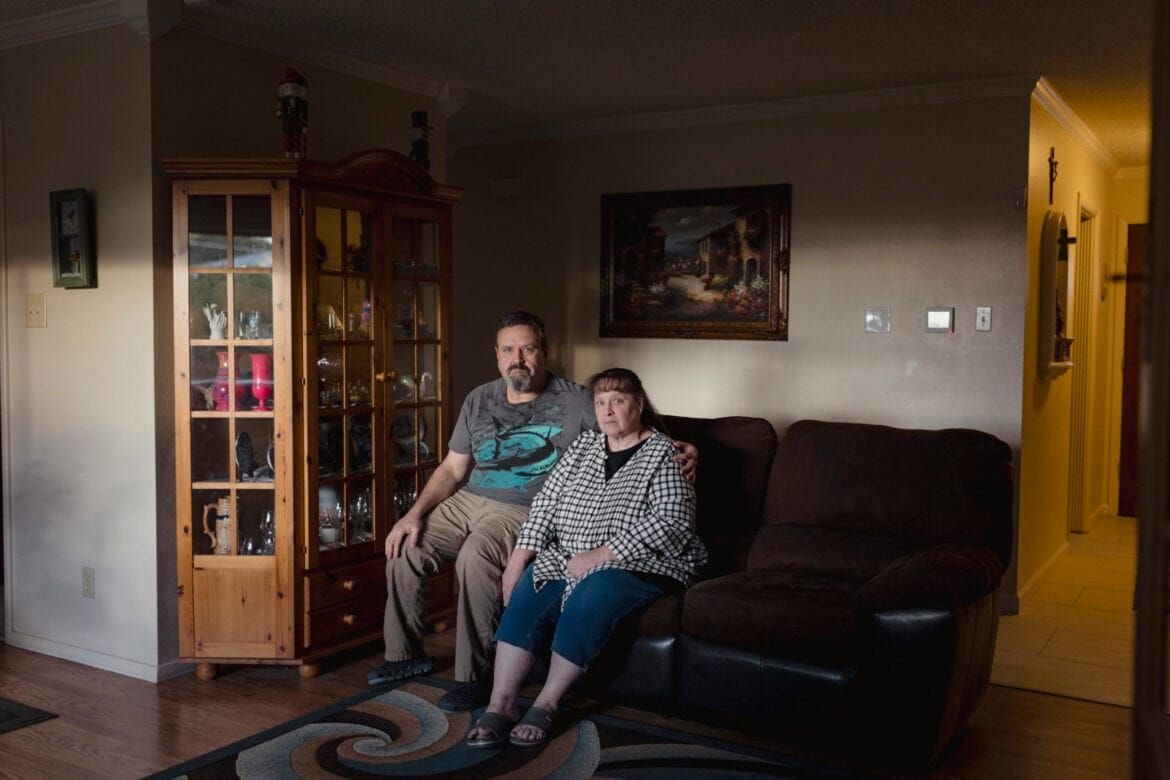
When Thaddeus “Tuk” Koslik arrived at an Albuquerque assisted living facility one Saturday morning in late August 2024, he tried to wake his dad, but couldn’t. Three days later, his father was dead.
A few hours earlier, a caregiver had given Joe Koslik medication from an oral syringe.
“Swallow it. It’ll help your stomach feel better, okay?” the caregiver said while rubbing the 76-year-old’s chest, seen in security camera footage of the interaction.
But the syringe didn’t contain Joe’s nausea medication, Tuk said in an interview with New Mexico In Depth. Instead, it held a powerful opioid painkiller called Dilaudid — administered twice in less than 24 hours without permission from the family or their hospice nurse, he said. State investigators later concluded that staff twice “administered the wrong medication to the resident.”
For Tuk, there would be no final conversation with his father, a retired railroad worker known for his even temperament. No final hug. No goodbye.
“Everyone who met him would say, ‘your dad is such a great guy,’” Tuk recalled.
At the time, he didn’t know his father had been given the wrong medicine.
Questions came later. Then an investigation by the state Division of Health Improvement, the part of the New Mexico Health Care Authority that inspects health care and long-term care facilities. And a lawsuit.
After the family filed a complaint with the state, DHI investigators confirmed medication errors and found broader problems with how staff handled and tracked medication, according to a December 2024 inspection report shared with the family and later obtained from the state by New Mexico In Depth.
Established in the late 1970s as a middle ground between independent living and skilled nursing homes, assisted living was intended for people who needed occasional help with daily tasks. But decades later, facilities now increasingly accept residents like Joe Koslik, whose needs are much more complex.
Tuk said he and his family trusted assurances from administrators at Morada Senior Living’s Albuquerque assisted living and memory care facility, Morada Albuquerque, that they could care for Joe when he moved there in April 2023, despite needing help to get out of bed or use the toilet.
Joe made the room his own. Family photos and a crucifix sat on his bedstand. On the walls hung two Pittsburgh Steelers blankets.
He grew up in Steubenville, Ohio, about 30 miles from Pittsburgh. “Sundays during football season were sacred. He’d tell people, ‘don’t call us during the Steelers game,'” Tuk said.
Morada assured the family it could handle Joe’s extensive medical needs, including his heart and lung problems, kidney disease, and dementia, according to a wrongful‑death lawsuit the family filed in state district court last November against Morada Senior Living, its parent company Discovery Senior Living, and a separate company, Ambercare Hospice, who the family hired to provide periodic nursing care. The defendants have denied the lawsuit’s allegations in court filings.
The family’s lawsuit alleges the medication errors on Aug. 30 and 31, 2024 led to Joe’s death. It also alleges the family witnessed other instances of neglect firsthand and captured neglect and abuse on a camera they installed in his bedroom. For example, Tuk at one point found his dad in urine-soaked clothing, the lawsuit states. And footage from the camera caught a staffer manhandling Joe while helping change his clothes, “throwing Mr. Koslik Jr.’ s body around like a rag doll and yelling at him for not complying,” according to the lawsuit.
The suit is ongoing. In May, a judge denied Morada’s motion to dismiss the lawsuit and compel binding arbitration between the facility and the Koslik family. The judge also denied Ambercare’s bid to be excluded from the case.
Morada, Discovery, and Ambercare have all denied liability for Joe Koslik’s death in court filings.
Attorneys for Morada and Discovery wrote that Morada “met or exceeded the applicable standard of care for a licensed assisted living facility in New Mexico” in Koslik’s case.
Christine Broucek, an attorney for Morada and Discovery, told New Mexico in Depth in an email that the businesses would not comment beyond the court filings.
“Because this matter is the subject of ongoing litigation and out of respect for the family, it would be inappropriate for us to comment on the specific allegations or pending legal proceedings. We take all matters involving the care, safety and well-being of our residents seriously and remain committed to providing quality care and cooperating with the appropriate regulatory authorities.”
Attorneys for Ambercare did not respond to emails from New Mexico In Depth. In a court filing, the company acknowledged that Koslik received care from Ambercare but “denies all allegations of negligence or wrongdoing with respect to that care, treatment, and services.”
No proactive inspections in 2025
Months before Koslik died in early September 2024, the state had already flagged problems with this facility during a round of surprise inspections, in May, and again after closing seven investigations sparked by complaints that summer.
In an investigation completed in December 2024, following Koslik‘s death, state inspectors identified signs of a broader breakdown in medication safety at Morada, including how the facility trained staff, stored medications, and recordkeeping, including how it documented and reported medication errors.
A New Mexico In Depth investigation raises questions about whether stronger state oversight could prevent medication errors and other mistakes at assisted living facilities like Morada.
The newsroom reviewed footage from Tuk Koslik’s security camera, state inspection reports, a state registry of reported abuse and neglect, residents’ medical and pharmacy records, recordings, text messages, and court filings. A reporter spoke with national experts, current and former staff at Morada and other facilities, and the families of a half-dozen residents.
Morada is not alone. New Mexico In Depth found similar problems at assisted living facilities across the state after reviewing hundreds of inspection reports.
Unlike nursing homes, assisted living facilities are not regulated by the federal government. States set the rules and enforce them.
In March 2024, New Mexico In Depth reported that 40% of the state’s assisted living facilities had not been inspected in more than four years, excluding a flurry of virtual check-ins early in the COVID-19 pandemic.
Two months later, in May, state inspectors conducted surprise inspections at long-term care facilities across the state. A June 2024 press release from Gov. Michelle Lujan Grisham’s office said 88% of 91 facilities included in the sweep failed at least one aspect of the inspections, ranging from “egregious incidents requiring immediate reporting to administrative violations of rules and regulations.”
Morada was one. The state referred Morada to the state’s Abuse, Neglect and Exploitation hotline because during the sweep, regulators encountered a family searching the halls for a resident who had wandered away. She was later found about a mile away.
Lujan Grisham and other state officials put the long-term care industry on notice, saying it would face closer scrutiny and more proactive inspections.
The point of proactive inspections is to make sure facilities comply with state laws and to identify problems before residents face prolonged or repeated risk. But despite promises to do better, the state conducted no proactive inspections of assisted living facilities in 2025, New Mexico In Depth found.
“The team didn’t have the capacity to do it,” then-New Mexico Health Care Authority Deputy Secretary Alex Castillo-Smith explained in an interview in April, promising that would change this year. The HCA was created by state lawmakers in 2023 as a hub for health care and behavioral health policy and for administering safety‑net programs such as Medicaid and SNAP (“food stamps”).
But even if inspections do increase, oversight will still fall short — not just because of enforcement failures but because New Mexico law sets a low bar to begin with. The laws governing assisted living set few requirements for admission, staff training, and accountability, leaving regulators with limited authority even when they are paying attention.
Take assisted living staffing and training requirements, for example. Staff members can provide unsupervised care for residents after just 16 hours of training, despite caring for medically fragile residents with complicated needs.
And while the state sets minimum staffing requirements, facilities are not required to regularly report proof that they are meeting them — leaving families with little way to know whether their loved ones are receiving adequate care.
When complaints are investigated, inspectors don’t always follow up.
For families trying to research a facility on their own, problems may also remain hidden because inspection reports are not consistently posted online.
Castillo-Smith acknowledged that some inspection reports are not making it into the public database, saying there is a backlog caused in part by inspectors’ 2025 transition from the Department of Health to the new Health Care Authority. She also mentioned the amount of time required to redact residents’ medical information.
“These survey reports require a high degree of redaction to patient privacy and we’ve not been able to upload all of the follow-up documents into the database,” she said. “We’re looking into how we can do that more quickly.”
In the April interview, Castillo‑Smith declined to say whether the state’s training requirements for assisted living staff are adequate but said her agency was reviewing and “trying to update” assisted living regulations. She called many of the state’s regulations “outdated,” and estimated the review would be finished by this summer.
That came as news to Timothy Fowler, the agency’s spokesman. In an April 9 email, he said the assisted living regulations were updated late last year, and that “there are currently no new plans for additional regulation revisions.”
On July 29, he added in an email, “if we need to go back and push for further updates, we will.”
Facing lax oversight, facilities have repeatedly failed to meet basic safety, training and recordkeeping requirements.
“It’s unacceptable,” said Charlene Harrington, a nationally recognized expert on long-term care facilities. “Some of these facilities should be shut down.”
From state inspection reports
Inspection failures
State complaint investigations in recent years documented repeated problems at assisted living facilities across New Mexico. Here are examples from those reports.
The facilities did not respond to a reporter’s emails seeking comment on the findings.
Desert Peaks — Las Cruces, 2024
Inspectors found that residents repeatedly wandered out of secured units and the building. In one case, a resident was found in a nearby street and returned by a police officer.
Staff failed to immediately report the incidents to the state. The report also found that residents’ falls, including some involving injuries, went unreported. One resident fell twice in one day; another had repeated falls.
Avamere — Rio Rancho, 2022–23
A 2023 complaint investigation documented short-staffing, residents with bed sores and food crawling with ants. Inspectors found the facility failed to provide enough staff to meet residents’ basic care, assistance and supervision needs, creating conditions that “could likely result” in its 84 residents being at risk of harm, injury or death.
A 2022 report also documented short-staffing, training failures and delayed responses to residents’ help-button calls. EMS workers found one resident “covered in ants”; an ER doctor later wrote that the resident was “likely not being checked on regularly,” based on the severity of the resident’s illness.
Autumn Blessings — Logan, 2022
Inspectors found residents on the floor after falls, including one resident who was found after five separate falls.
The facility did not report the incidents to the state or complete required internal investigations. Inspectors also found that resident medication lists were not on file.
Life Spire Assisted Living — Rio Rancho, 2022
Inspectors documented poor recordkeeping, failure to submit new hires’ fingerprints for criminal background checks within 20 days and unsafe oxygen-tank storage.
Residents’ medications were missing from medication administration records and medication-distribution carts, raising concerns about missed doses.
Coming surge
The state’s already weak oversight faces mounting pressure, as New Mexico’s elderly population grows faster than almost anywhere else in the country. By 2030, a third of New Mexico residents will be 60 or older. By 2040, the number of people 85 and older will more than double from 2020 levels, according to University of New Mexico demographers.
That surge will push thousands more New Mexicans into searching for care.
Very sick patients, including those with advanced dementia, need round-the-clock medical care at skilled nursing homes, experts say. But because of high costs, many families turn instead to assisted living facilities.
Asked whether the state is ready for the coming demographic surge, Castillo-Smith replied: “I don’t think the country is ready. I think New Mexico is doing the best they can to meet that unique demographic challenge.”
Joe Koslik needed close help with daily living and a complex medication schedule. His father’s death still haunts him, Tuk said. “I don’t think it will ever rest well with me if I don’t feel like some justice was done.”
Taken together, gaps in staffing, training, oversight, and inspections create conditions in which serious harm is not just possible, but foreseeable, long-term care experts say.

Not enough staff, not enough training
Determining how many caregivers were on duty when Joe got the wrong medication at 5 p.m. on August 30 — and again 16 hours later — is difficult because no public record discloses Morada’s staffing levels.
Unlike nursing homes, which must report daily staffing levels to the federal government, New Mexico’s assisted living facilities are not required to report how many staff are on duty each day. State law says facilities must have “sufficient number of staff” for basic care, but sets a low bar: one caregiver for every 15 residents during the day.
At night, facilities with 16 to 30 residents are required to have just one caregiver awake and on-site, with one other person available if needed.
But it is unclear how the state confirms facilities are following these rules.
State inspectors can request staffing ratios from the previous 30 days. But without regular reporting on staffing levels or resident counts, there is no easy way for regulators or families to know which facilities are following the requirements.
“That’s a recipe for disaster,” especially for facilities in memory care units and at night, said Cristina Flores, a former owner-operator of a California assisted living facility, of the minimal staffing requirements. Residents with dementia or who display aggressive behavior toward others can sometimes require one-on-one staffing, Flores said.
“[I]n a memory care unit with 25 people, probably at least 75% of them need either assistance with the bathroom, reminders to [go to] the bathroom, or are incontinent and need diaper changes,” Flores added. “So how is one person at night going to possibly meet those needs? It’s impossible!”
Burnout and mistakes can become inevitable when there aren’t enough staff. Workers themselves are caught in the middle, facing long hours of emotionally demanding work for low pay.
“The direct care staff are often victims themselves,” Flores said. “They’re underpaid workers” frequently dealing with impossible situations.
Federal rules require nursing home staff to complete 75 hours of classroom and hands-on training before they’re certified.
Assisted living facilities are not subject to similar standards.
Instead, responsibility for protecting residents in assisted living facilities falls to the states. In New Mexico, the training requirements are just as minimal as the staffing requirements. After an initial 16 hours of training, staff receive 12 hours of instruction each year, in a state-approved training program. No nursing degree or medical training is required — just a background check.
Workers can become certified by the assisted living facility to help patients administer their own medications simply by watching a video, according to current and former Morada staff.
Some facilities skip even minimal steps required by the state, inspection reports show.
Time and again, inspectors found no records on file that facilities checked new hires for criminal backgrounds, or had checked the state Employee Abuse Registry meant to bar workers who abused, neglected, or exploited patients from being hired again.
Inspection Failures
A review of state inspection reports shows another recurring pattern: inspectors document serious problems, facilities pledge fixes, but public records available in the state’s online inspection report database do not always show that the state confirmed the promised corrections.
When inspectors visited Morada in December 2024, they cited serious violations, including a failure to lock up dangerous drugs.
Nor did the facility report Koslik’s medication error to the state within 24 hours, as required — or conduct an internal investigation within five days, as required. They also failed to alert Koslik’s physician to the errors, according to the report.
Inspectors also noted that residents did not always get their medications as prescribed.
Administrators pledged in writing to fix the problems.
But in April 2025, inspectors returned in response to new complaints, and found additional medication safety lapses, including missing drugs, missed doses, and wrong doses.
Morada again drafted a plan of correction, promising improvements in staffing, incident reporting, assessments and service plans, and audits of medication records.
State officials later told New Mexico In Depth that inspectors reviewed records remotely in August 2025 to confirm Morada had done so. And on July 29, a week before this investigation was published, Fowler told New Mexico In Depth inspectors again re-assessed the facility on April 16, 2026, this time in person.
Neither report as of July 17 appeared on the state’s public inspection database. When New Mexico In Depth checked the database July 29 to see if the most recent reports had been added, the website noted it was “temporarily unavailable.” It’s unclear when the database will be available again, according to Fowler, who said New Mexico In Depth could file a public records request to obtain inspection reports.
Morada was not fined for deficiencies — or for any other problems identified there in recent years, state officials said. “Morada fixed the deficiencies cited in survey reports,” Fowler wrote in an email. “None of those deficiencies met the criteria for fines.”
Fowler insisted the state follows up to verify problems are corrected after inspections. “This is what we did with the Morada facility after receiving the complaint from Joe Koslik’s family.”
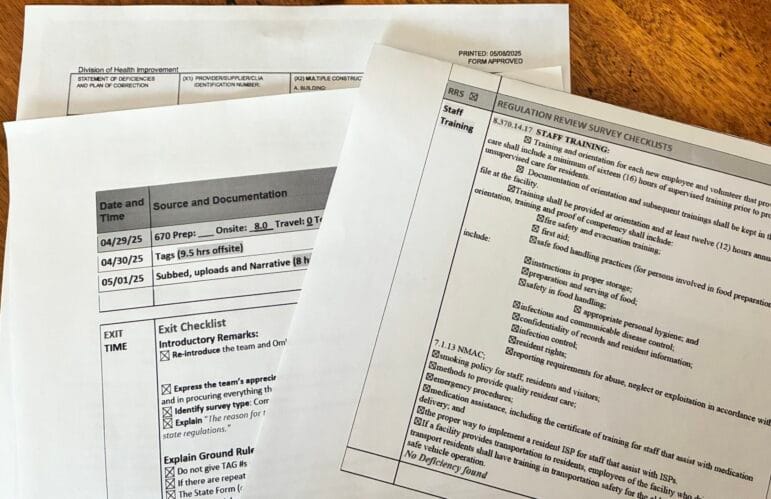
In 2025, the state HCA Division of Health Improvement’s 12-member inspections staff received 288 complaints about assisted living facilities and investigated fewer than half of them — 126 cases — according to state data.
The state’s approach can leave serious issues unaddressed for months or years unless a facility discloses them or someone else reports a problem.
State law and regulations require facilities to conduct employee background checks, report serious safety lapses, and document medication errors in resident files. But without regular inspections, it is unclear how the state confirms facilities are following those rules.
After the state’s May 2024 surprise inspections, Lujan Grisham and other officials promised more scrutiny of these facilities, including proactive inspections. But the state didn’t conduct proactive inspections of assisted living facilities in 2025.
Castillo-Smith said that was because it lacked enough inspectors. But she said five new inspectors have been hired this year, bringing the staff to 17, and that the new hires will begin surveying facilities this summer. (New Mexico In Depth could not confirm the new hires in State Personnel Office staffing and vacancy reports, which showed unchanged staffing levels for the inspections bureau from 2025.)
Those five new inspectors would be a step toward closer oversight of assisted living facilities, Castillo-Smith said.
“They’ll be able to start doing those routine regulatory reviews,” she said.
Unlike nursing homes, which receive annual inspections, the plan is for inspectors to go into assisted living facilities at least once every three years, Castillo-Smith said. (That would work out to the state conducting about six inspections a month, according to Fowler, the HCA spokesperson.)
“We agree that we need to improve, but we’re confident we’re going to start this summer with more routine regulatory [inspections],” Castillo-Smith said in April.
In a July 29 email, Fowler said that newly-trained inspectors “began conducting proactive inspections of assisted living facilities as of July 2026, and we are continuing to build on that commitment of stronger oversight.”
While the state has been lax in conducting regular unannounced inspections on its own initiative, complaint investigations have increased and regulators have imposed more fines in recent years, including $32,400 against seven assisted living facilities in 2025 and $35,300 in 2024, up from $2,600 in 2023.
About a third of the 2025 fines — $11,000 — was imposed against All-Care Assisted Living in Clovis, an eight-bed facility fined three times, including after an administrator used a resident’s ATM card for grocery trips and nearly $1,000 in cash withdrawals. The administrator pleaded guilty in January 2026 to fraudulent use of a credit card, and All-Care no longer appears in the state’s database of licensed assisted living facilities.
And in 2024, MorningStar Memory Care at North Ridge in Albuquerque was fined $8,000 after staff restrained a resident by wrapping them in a blanket to immobilize them and tying a shirt around their ankles. MorningStar no longer manages the facility.
A spokeswoman for Anthem, which now manages North Ridge, wrote in a July 31 email in response to New Mexico In Depth’s request for comment, that “The incident you referenced occurred before our company assumed management of the community. As we were not involved in the community’s operations at that time, we do not have firsthand knowledge of the circumstances and are unable to comment on the matter.”
Families left in the dark
Finding a safe assisted living facility is no easy task.
Complaints to state inspectors are kept from the public. Only problems confirmed by inspectors are supposed to be disclosed to the state’s inspection database. Even then, the database is difficult to search.
Records from state ombudsman programs, which help residents and families resolve problems with care facilities, are also largely confidential under federal and state law, to protect vulnerable people.
The state ombudsman can release records when doing so is in the public interest, so long as residents are not identified. But the default remains secrecy, leaving the public unaware of potentially dangerous facilities.
The state also does not assign quality ratings to assisted living facilities the way the federal government does for nursing homes.
Joe Koslik’s son, Tuk, searched Google reviews and asked around. He found an online advisor who recommended Morada based on the family’s budget and Joe’s transportation needs.
“We get star systems for restaurants — why don’t we have them for care facilities?” Tuk asked.
The process for most New Mexico families is “hoping you picked a good one,” he said.
He never found the state’s inspection database despite repeated searches.
“I’m not saying it doesn’t exist, but … if you put in Google, ‘assisted living [and] Albuquerque’, then the state’s website should pop up, right?”

Many families rely on “free” placement services. But because the facilities themselves pay for referrals, those services can present conflicts of interest. Castillo-Smith said the state can’t build a public ratings system because inspectors haven’t yet gathered consistent survey data from all facilities. With the five new inspectors starting work this summer, that will change, she added.
The consequences of the lack of transparency can be severe. If Koslik’s son had not installed a security camera after suspected thefts, no one might have known Joe was given Dilaudid instead of nausea medication, or the abuse alleged in their lawsuit.
Assisted living apartments can seem an attractive, cozy, home-like alternative to costly and impersonal skilled nursing homes. In New Mexico, where incomes and savings tend to be lower than in other states, affordability is often the deciding factor.
Marketing materials and tours frequently blur the lines between skilled nursing care and assisted living, spotlighting memory care units and promising personalized, expert care that is sometimes contradicted by state inspection reports.
“We are working to get information into families’ hands faster and easier,” Fowler said in a July 29 email. “We want the public to know that anyone can request public records, including complaint investigation reports for any licensed healthcare facility from the HCA.”
For now, state regulators continue to rely largely on facility self-reporting and complaint-triggered inspections — reactive measures that begin only after someone reports a problem.
And families continue to place cameras in their loved ones’ rooms.
This investigation was supported with funding from the Data-Driven Reporting Project. The Data-Driven Reporting Project is funded by Arnold Ventures and the Google News Initiative in partnership with Northwestern University | Medill
A data editor confirmed the analysis used to identify trends from state inspection reports.
Bryant Furlow is a public health journalist and frequent contributor to The Lancet's medical journal news desks. Contact Bryant at bryant.furlow@protonmail.com or text/Signal him at 505-440-0055.
Keep Reading
New Mexico seeks public input on future PFAS protections for consumer products — An Aug. 18 webinar and public comment process will help shape recommendations on exemptions in the state’s law regulating so-called “forever chemicals.”
New Mexico environment department updates public comment portal following fraud reports — Commenters will now receive verification emails after about 42 Project Jupiter submissions were reported as potentially fraudulent.
Las Cruces-shot film ‘Olmo’ opens in theaters nationwide — The coming-of-age film was shot in the Tortugas neighborhood, downtown Las Cruces and other locations around the city.