What southern New Mexicans say they need from local news
A new Organ Mountain News assessment finds southern New Mexicans want clearer civic reporting, broader community coverage and stronger follow-through.
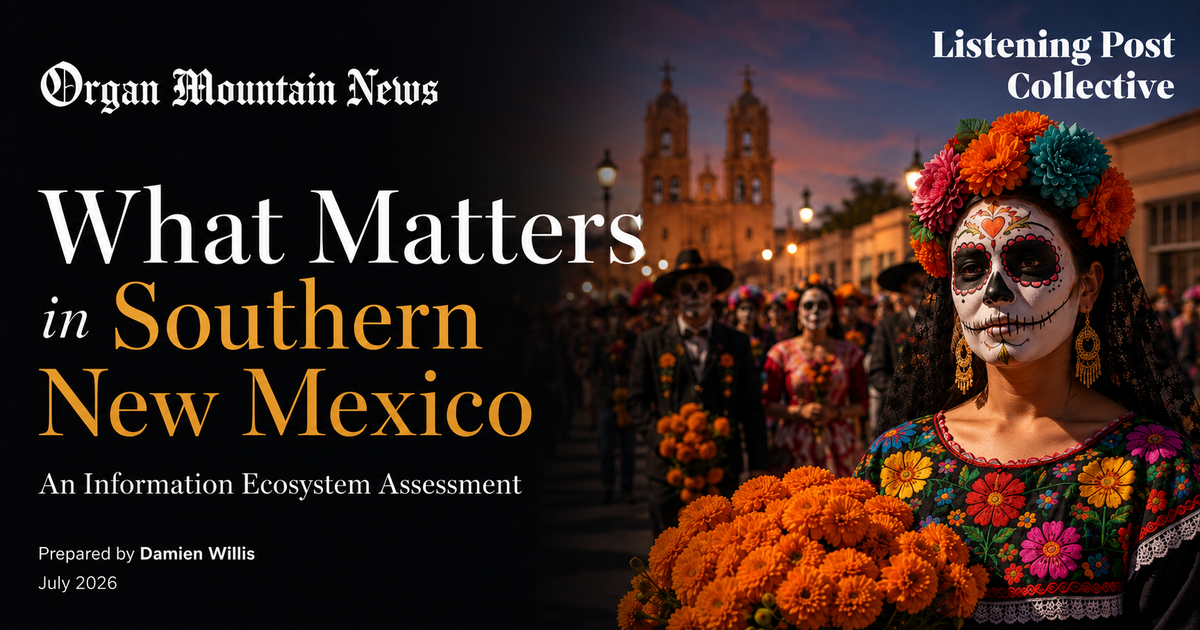
OMN’s community listening report finds residents want clearer civic information, broader representation and evidence that public participation matters
Damien Willis, Organ Mountain News
LAS CRUCES - Southern New Mexicans are not simply asking for more news.
They want information that helps them understand who has authority, how decisions are made, when the public can participate and what happens after residents raise concerns, according to a new community listening report released by Organ Mountain News.
The 78-page assessment, What Matters in southern New Mexico, examines how residents find, evaluate and share local information, which issues and communities receive too little attention and how OMN should respond.
Read the full report
Download What Matters in southern New Mexico: An Information Ecosystem Assessment.
Download the full reportOMN conducted 24 guided one-on-one interviews with residents, journalists, educators, community leaders, service providers and institutional representatives. An open online survey generated 315 submissions, of which 290 were retained after likely duplicates and low-quality or synthetic responses were removed.
Among the retained respondents, 266 provided at least one usable open-ended response.
The survey was voluntary and not statistically representative. Its percentages describe the people who participated, not the population of southern New Mexico as a whole. Interviews were also concentrated in Las Cruces and among people already connected to civic, professional or community institutions.
Even with those limitations, recurring patterns emerged across the interviews and survey responses.
Residents described an information environment crowded with social media posts, government announcements, breaking-news alerts and word of mouth, but lacking enough verified context, practical explanation and consistent local follow-up.
Concern about speaking publicly
One of the assessment’s most striking findings involved residents’ reluctance to participate publicly.
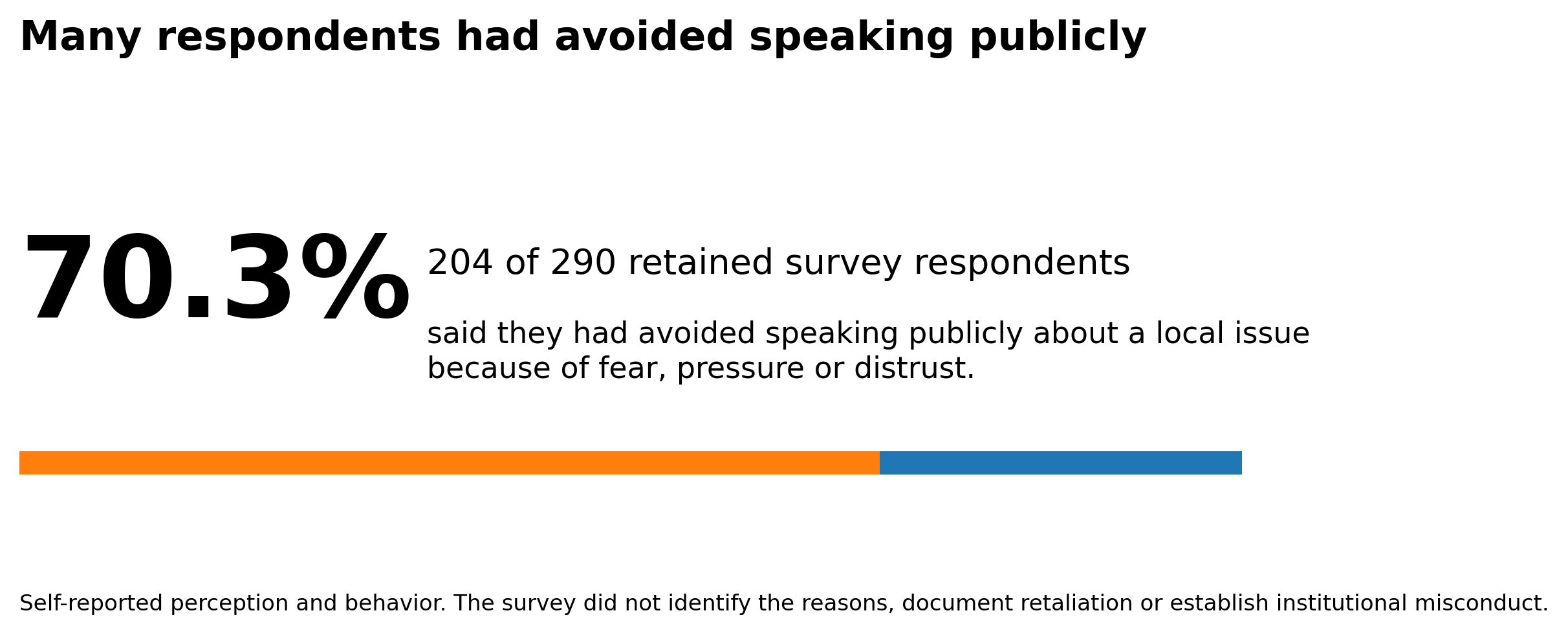
Of the 290 retained respondents, 204 — 70.3% — said they had avoided speaking publicly about a local issue because of fear, pressure or distrust.
The question did not establish why individual respondents remained silent, whether retaliation occurred or which people or institutions may have contributed to that concern. The result is a self-reported measure of perception and behavior, not proof of misconduct.
Still, the scale of the response raises questions about whose perspectives appear in public meetings, news coverage and official decision-making.
People with direct experience or knowledge may remain absent from public forums for reasons the assessment could not identify. Visible participation, therefore, cannot automatically be assumed to represent everyone affected by a decision.
That finding also points toward the need for private, anonymous and lower-risk ways for residents to share information with news organizations.
Accountability before decisions are final
Participants expressed strong interest in local government accountability, public spending and institutional decision-making.
But they did not merely want coverage after a controversy erupted or a decision became final.
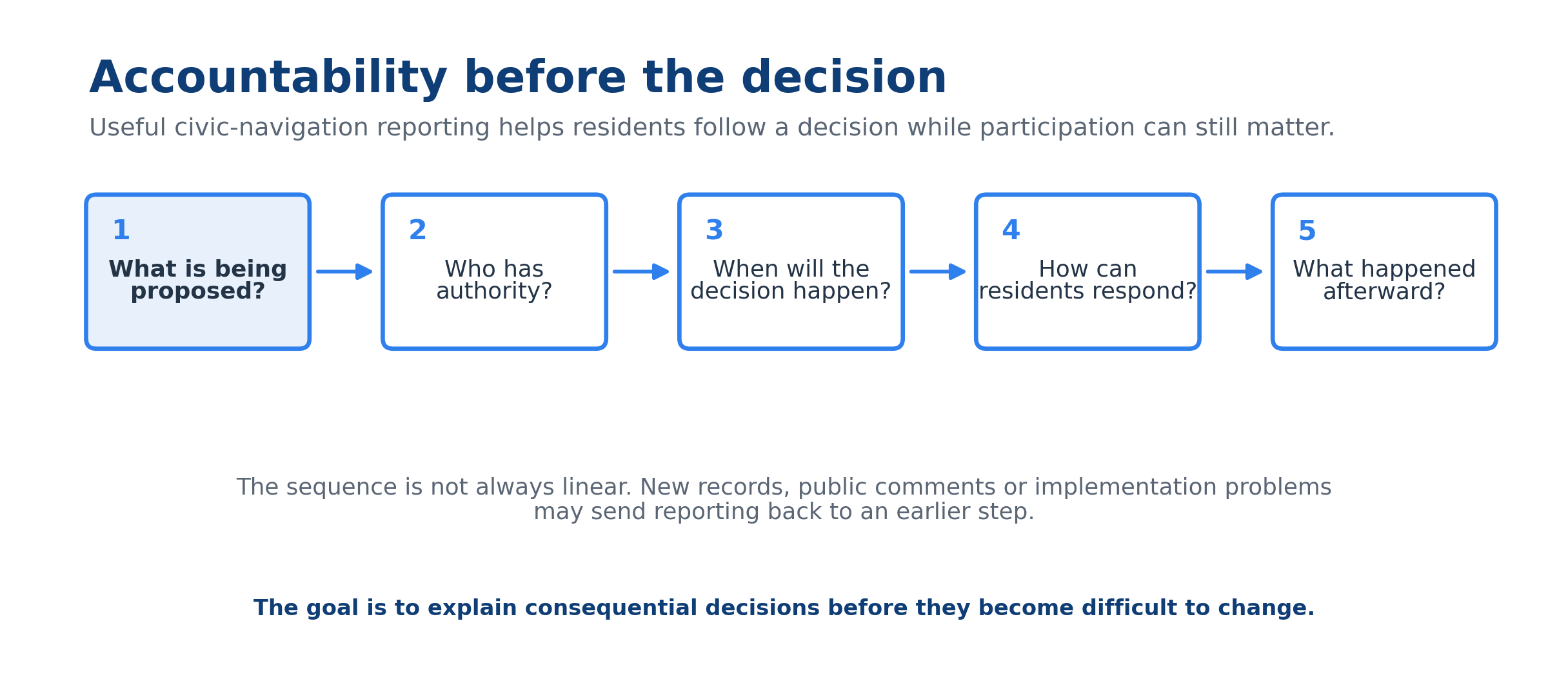
They wanted reporting that explains proposals, authority, costs, tradeoffs and opportunities for public participation while residents can still influence the outcome.
That means identifying which agency or elected body has jurisdiction, explaining how a public process works and telling residents when and how they can participate.
It also means following stories after public meetings, announcements and initial controversies fade from attention.
The assessment found that residents often struggle to understand not only what happened, but who was responsible, what came next and whether public input affected the result.
Community life was the most common coverage request
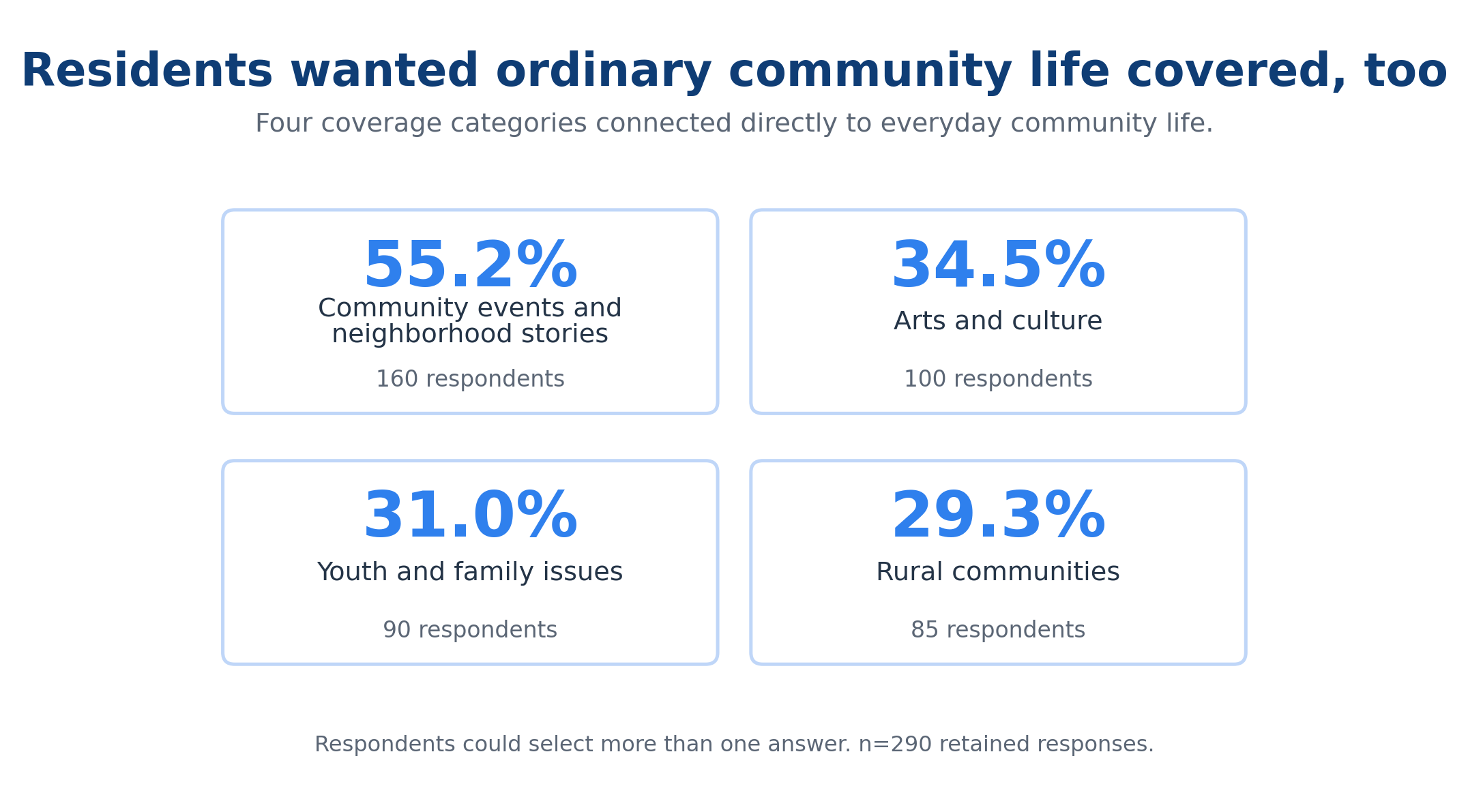
Community events and neighborhood stories were the most frequently selected type of desired coverage, chosen by 160 retained respondents, or 55.2%.
Local government accountability was selected by 132 respondents, or 45.5%, while 109 respondents, or 37.6%, asked for more explanatory and service journalism.
The demand for community-life coverage did not reflect indifference to government, public safety or economic pressures. Respondents also requested reporting on health care, housing, jobs, water, schools and the cost of living.
Instead, participants said communities are too often represented only through crime, conflict, political controversy or disaster.
They wanted schools, small businesses, culture, neighborhood activity, youth achievement and ordinary civic life documented with the same seriousness applied to crisis.
“A lot of people in southern New Mexico feel invisible unless there’s a crisis, crime story, or political controversy,” one Las Cruces respondent wrote. “Communities want coverage of everyday life too — schools, small businesses, culture, and local successes.”
The report does not call for boosterism or uncritical positive coverage. It calls for journalism that examines what is working, who is contributing, where gaps remain and how other residents can participate.
Geography and language shape access
The report also cautions against treating southern New Mexico as a single, undifferentiated community.
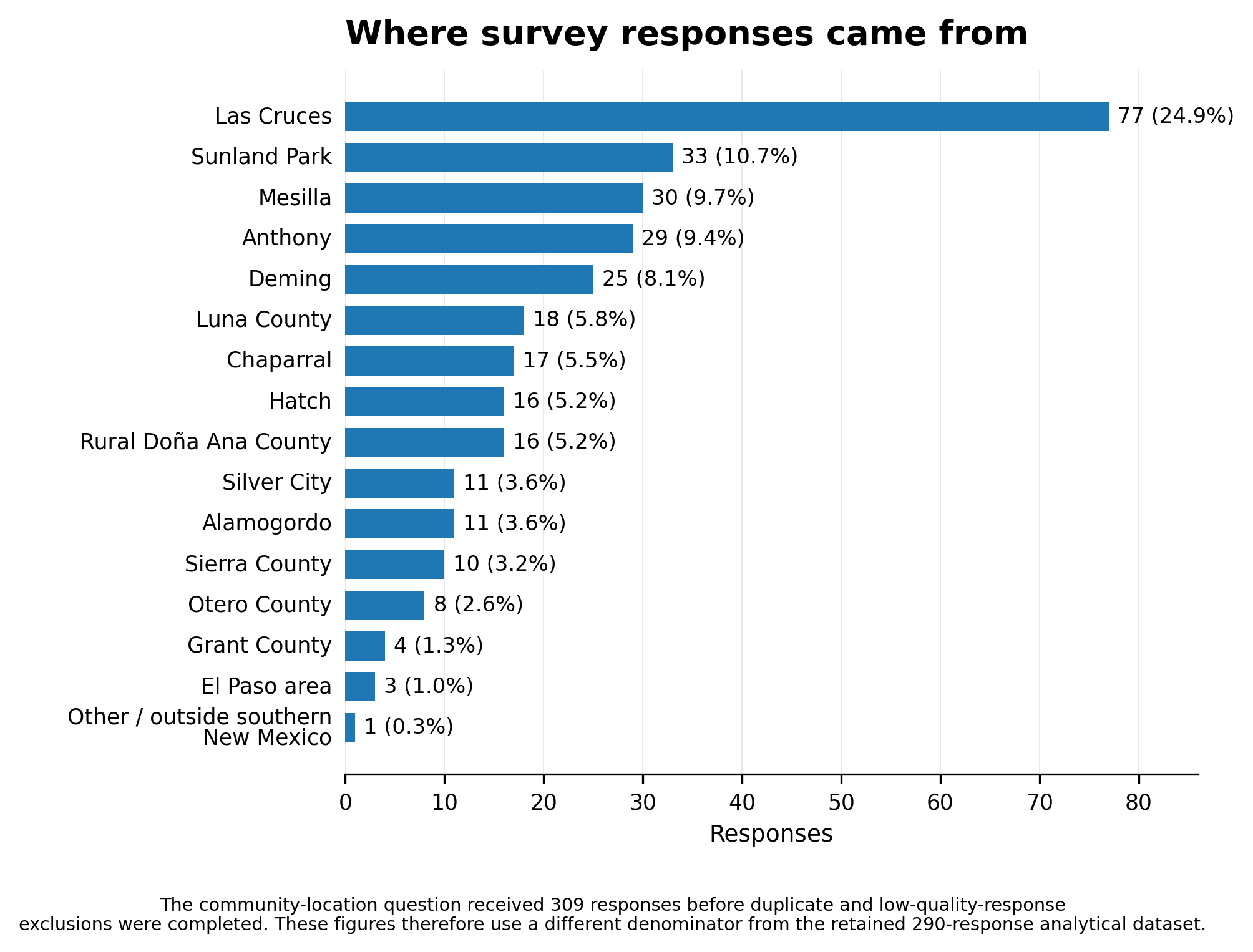
Las Cruces is the region’s largest population and institutional center, but it does not represent the experiences of all Doña Ana County residents.
Distance affects access to services, transportation, public meetings and local news. Participants described distinct information needs in South County, colonias, rural areas, agricultural communities, smaller municipalities and neighborhoods that receive little sustained coverage.
Language remains another significant divide.
The project included outreach in Las Cruces, Hatch, Anthony, Sunland Park and surrounding communities, along with printed materials, QR codes, community events and distribution through trusted organizations.
However, the assessment did not develop a strong enough Spanish-language evidence stream. Spanish-speaking residents, young people and people with limited internet access were among the groups the project did not hear from deeply enough.
Future listening will require more deliberate, sustained and varied outreach rather than relying primarily on digital surveys and existing civic networks.
Daily pressures are interconnected
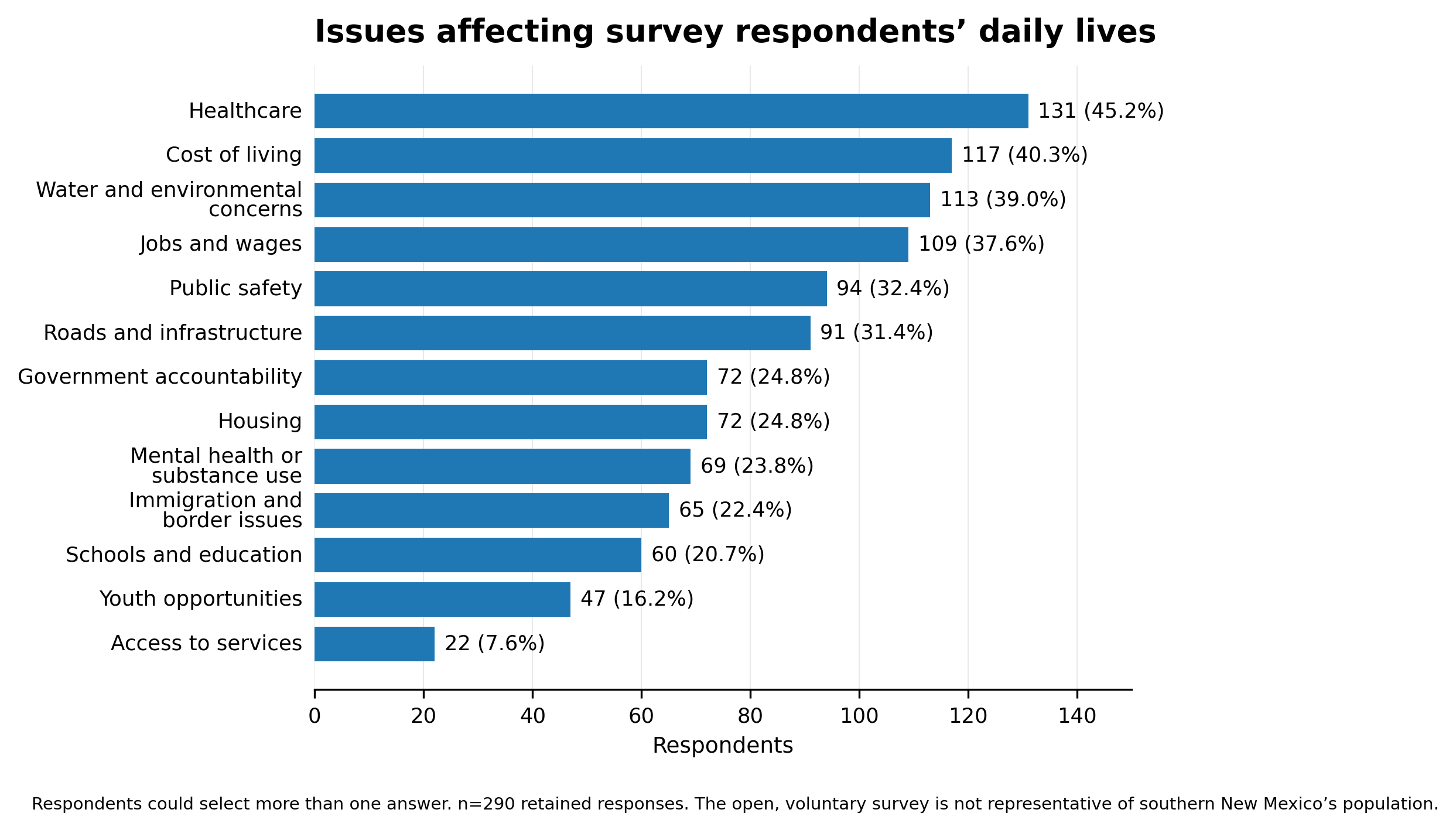
Healthcare was the most frequently selected daily-life concern, identified by 131 respondents, or 45.2%.
Cost of living followed at 117 respondents, or 40.3%, while 109 respondents, or 37.6%, selected jobs and wages.
Participants also raised housing, schools, transportation, water, behavioral health and access to public services.
Interviews helped show how those concerns intersect.
The loss of a local medical provider can require residents to travel hours for care. Rising housing costs can destabilize families already managing low wages. Schools are often expected to absorb needs created by poverty, mental health challenges and limited family resources. Rural distance can turn an inconvenience into a significant barrier.
Participants wanted reporting that reflects those connections rather than treating each issue as an isolated subject.
Public safety extends beyond enforcement
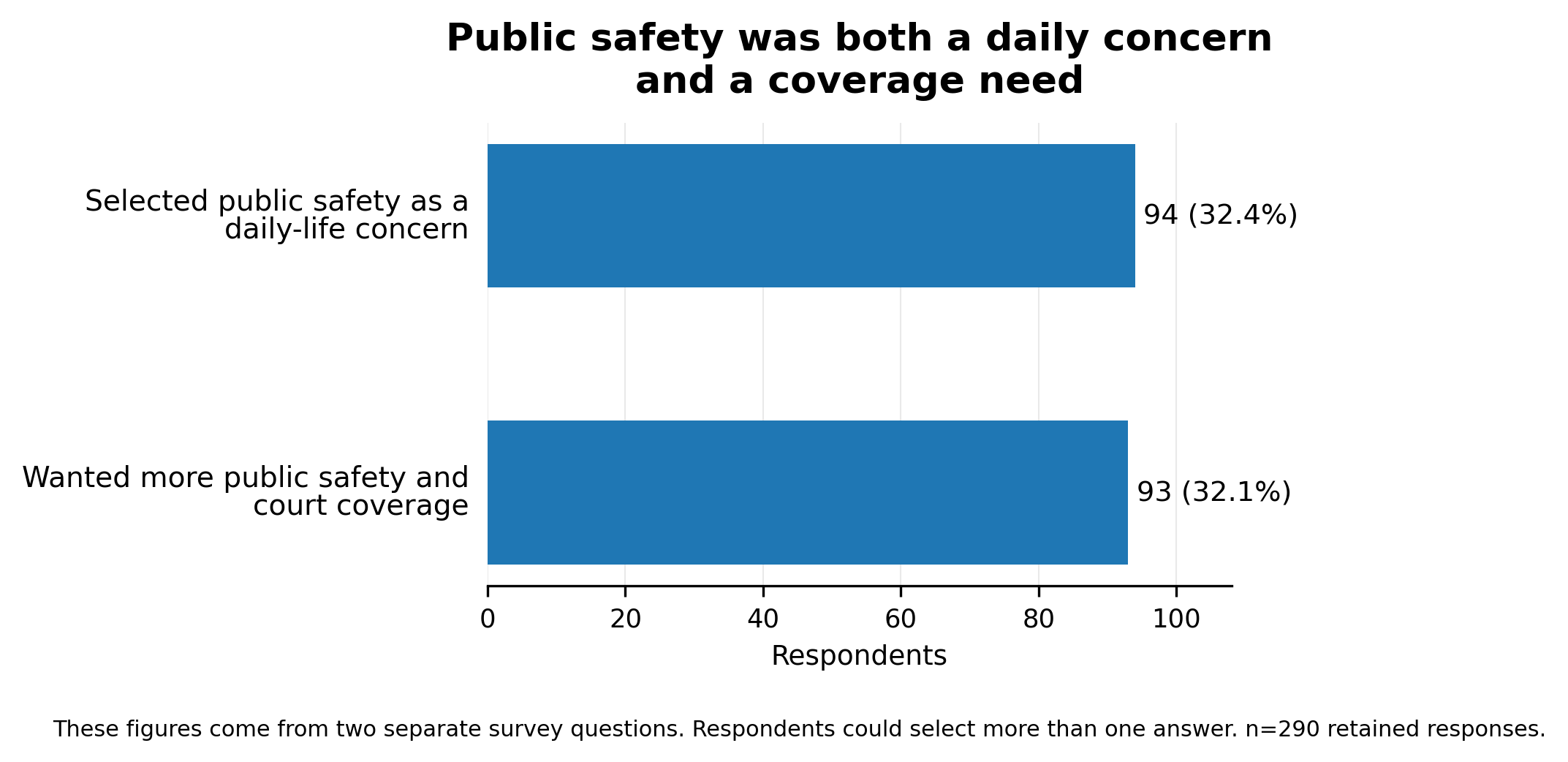
Public safety remained a major concern, selected as a daily-life issue by 94 respondents, or 32.4%. Ninety-three respondents asked for more public safety and court coverage.
But participants also challenged journalism that treats enforcement as the sole measure of safety or portrays young people, unhoused residents and entire neighborhoods primarily as threats.
Interview participants connected safety to youth belonging, behavioral health, housing, family support, institutional trust and access to social services.
They wanted timely and precise incident reporting, along with deeper examination of whether policies work, why harm recurs and how prevention systems function.
The assessment recommends that OMN distinguish clearly among allegations, confirmed facts and unresolved claims, use trend data when available, follow cases and policies beyond their initial announcement and examine whether public-safety spending produces measurable results.
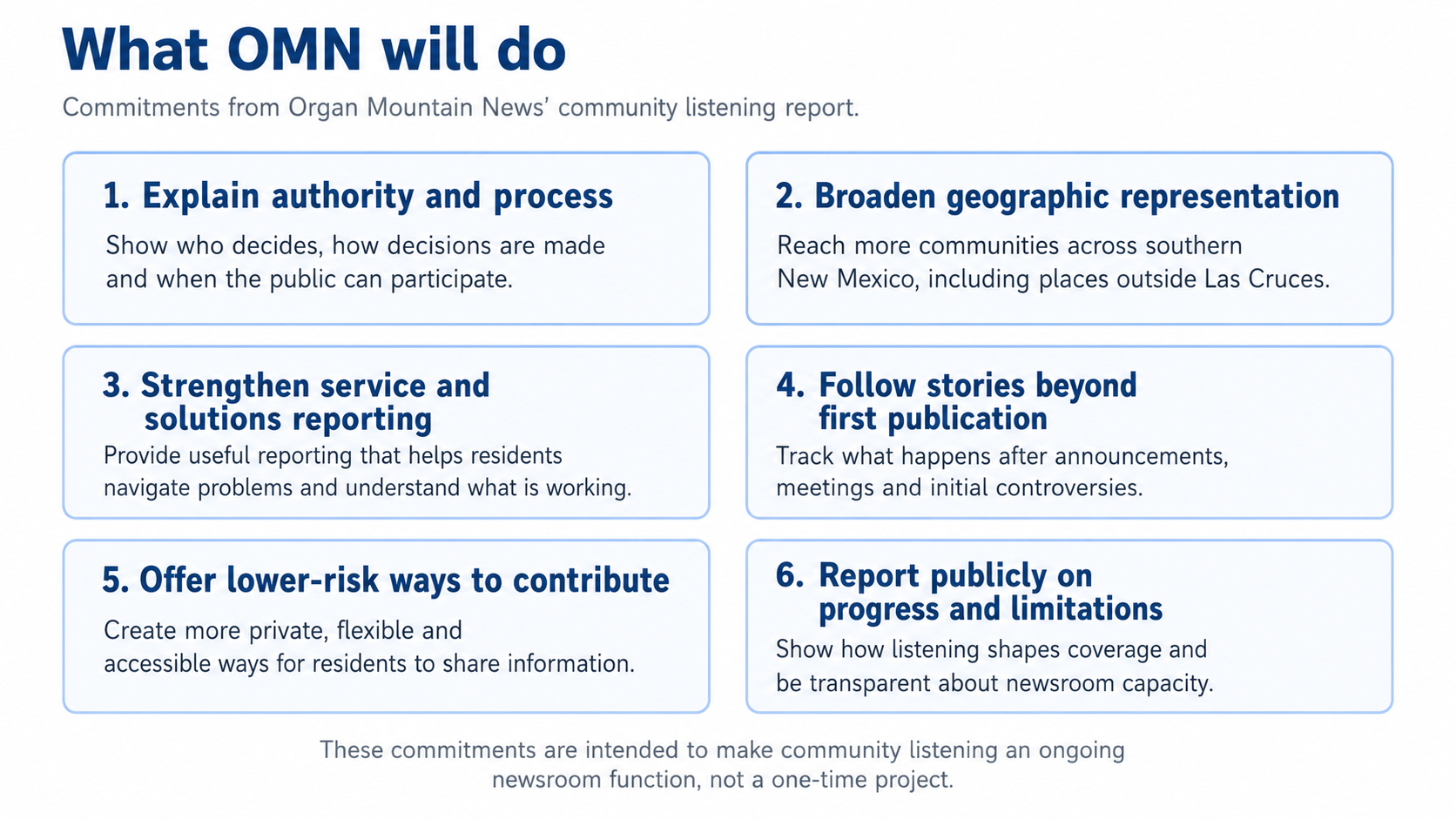
What OMN will do
The assessment is not only a description of what participants said. It establishes commitments for how Organ Mountain News will respond.
The newsroom will place greater emphasis on explaining authority, process and opportunities for public participation before decisions are final.
OMN also will work to broaden geographic representation, strengthen service and solutions-oriented reporting, follow stories after initial publication and offer lower-risk ways for residents to contribute information.
Community-life coverage will be treated as a core public-service function rather than an occasional departure from more serious news.
The newsroom also plans to track whose voices and communities appear in coverage, explain more clearly what remains unknown and be transparent about what a primarily one-person newsroom can and cannot provide.
Some changes can begin immediately. Others — including sustained Spanish-language engagement, regular group listening sessions and deeper coverage across a large geographic region — will require additional funding, partnerships, staffing or expertise.
The report provides a baseline against which OMN can evaluate future progress.
The newsroom plans to maintain an ongoing community listening mechanism and publish periodic updates about how resident input influences coverage, engagement and newsroom priorities.
Residents gave Organ Mountain News their time, experiences, criticism and trust.
The value of that participation will not be measured by the publication of a 78-page report. It will be measured by whether the journalism changes — and whether residents can see evidence that listening mattered.
Damien Willis is founder and editor of Organ Mountain News. If you have a personal story to share or a lead we should follow up on, reach out at OrganMountainNews@gmail.com or connect with him on X at @damienwillis.
Keep Reading
Doña Ana County commissioners terminate Manager Scott Andrews’ contract — Commissioners voted unanimously to remove Andrews without cause, effective immediately.
Review: Why AMC’s ‘Dark Winds’ stands apart — Jack Davis considers how the series’ Navajo setting, Native cast and cultural perspective distinguish it from other police dramas.
Heinrich urges tighter limits on prediction markets to protect tribal gaming — New Mexico pueblos and the Mescalero Apache Tribe backed safeguards against nationwide sports betting and casino-style contracts.