
Tortugas dam faces $74 million rehabilitation as engineers warn of flood risk
Federal planners favor a $74 million rehabilitation of Tortugas Site 1 Dam, a high-hazard flood-control structure east of NMSU that engineers say no longer meets safety standards.
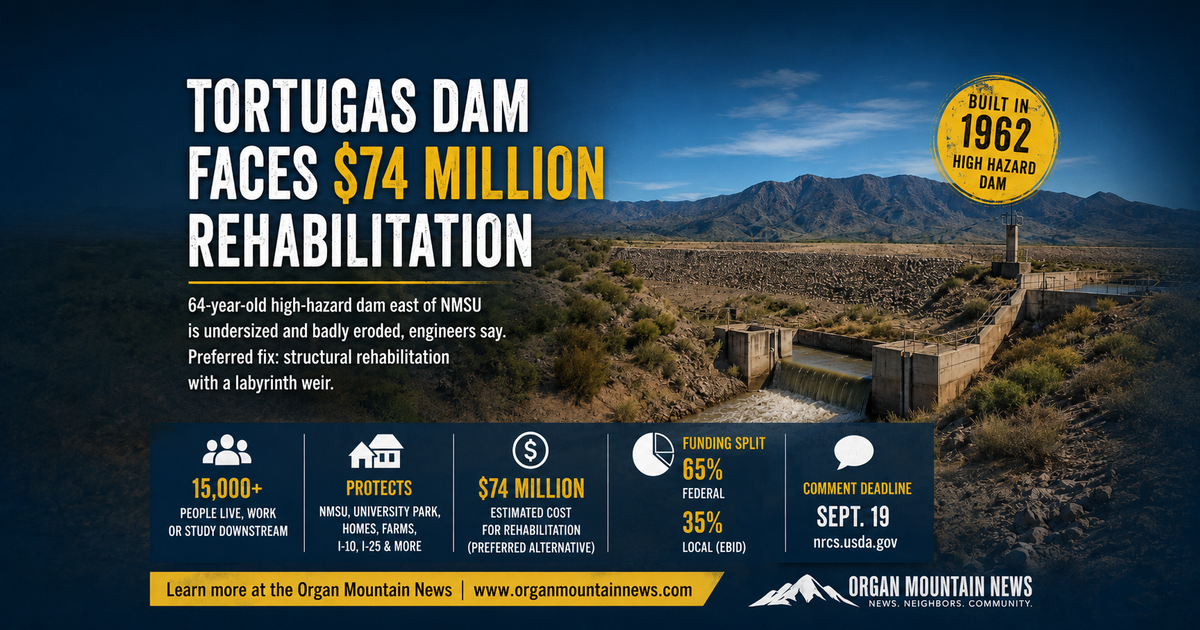
Federal planners have selected a structural overhaul of the aging Tortugas Site 1 Dam, which protects NMSU, University Park, major transportation routes and hundreds of downstream properties
Damien Willis, Organ Mountain News
Correction: An earlier version of this story incorrectly attributed a question about Brazilian free-tailed bats near East University Avenue and Dripping Springs Road to Marnina, a resident who attended the Aug. 20 meeting. Marnina later clarified that the question was submitted by another, unidentified participant through the meeting chat. The reference has been removed.
LAS CRUCES - A 64-year-old flood-control dam east of New Mexico State University is hydrologically undersized, badly eroded and could overtop during the extreme storm it is supposed to withstand, according to federal engineers now recommending an estimated $74 million rehabilitation.
The U.S. Department of Agriculture’s Natural Resources Conservation Service and Elephant Butte Irrigation District presented the preferred alternative for Tortugas Arroyo Watershed Dam Site 1 during a public meeting Thursday, Aug. 20.
The earthen dam, built in 1962 and modified in 1968, is classified as a high-hazard potential dam because failure could result in loss of life.
Its downstream footprint has changed substantially since it was built.
The dam now protects New Mexico State University’s main campus, University Park, Tombaugh Elementary School and nearby residential areas, along with about 2,200 acres of irrigated farmland, Interstate 10, Interstate 25, railroad infrastructure, power and water lines and fiber-optic cables.
Federal officials say roughly 15,000 people study, live or work downstream.
The dam was originally constructed to control flooding and trap sediment carried through Tortugas Arroyo. Before its construction, the arroyo routinely flooded agricultural land and filled irrigation canals with sediment and debris, sometimes interrupting water deliveries until emergency repairs could be made.
Its construction also helped make later development around NMSU and portions of Las Cruces practical by reducing the flood threat.
But the structure no longer meets current federal and state dam-safety standards.
Engineers told meeting participants the dam is hydrologically undersized and would overtop during the project’s design storm, described during the presentation as an event producing roughly 18 to 20 inches of rain within 24 hours.
Support local journalism
Organ Mountain News provides independent reporting for southern New Mexico without a paywall. If you value this work, please consider supporting the newsroom with a one-time or monthly contribution.
Support Organ Mountain NewsThe embankment lacks modern filter protection and drainage systems, has severe gully erosion and has an undersized principal spillway riser. Sediment accumulation is another concern: Without removal, planners said sediment could effectively bury the dam within about 50 years.
Subsurface investigations began in 2020 and continued into 2021 before work stalled after a contract was canceled. The project resumed in 2024.
Four alternatives considered
Planners evaluated four broad alternatives.
The first was taking no federal action and accepting the existing risk. That option was rejected because of the population and infrastructure downstream.
A second alternative would breach the dam and acquire downstream property to clear the flood path. Planners said more than 400 structures and residents would be affected, while removing the dam would also eliminate the flood-control function it was built to provide.
The preferred alternative is structural rehabilitation.
Two structural approaches were considered: an overtopping spillway and a labyrinth weir, a spillway design that uses a folded or zigzag configuration to allow more water to pass through a limited width.
Planners selected the labyrinth-weir option, with an estimated cost of about $74 million.
A fourth alternative would breach the existing dam and construct a roughly 16-mile flood-control channel with two sedimentation basins. Sediment would have to be removed from the basins about every four years.
That option was rejected because of the extensive construction required and an estimated price tag of about $184 million.
Who pays for it?
The preferred alternative also raises a substantial funding question for EBID.
Under the NRCS Watershed Rehabilitation Program, the federal government can pay 65% of eligible construction costs while the local project sponsor is responsible for the remaining 35%.
EBID is the local sponsor.
If the entire $74 million estimate represented eligible construction costs, a 35% local share would equal about $25.9 million. That does not necessarily mean EBID would ultimately pay $25.9 million from district funds.
NRCS funding applies to construction and does not cover expenses such as permitting and licensing. Officials also said local sponsors may seek assistance from state lawmakers to help cover the nonfederal share.
No final financing package was presented Thursday.
Marnina, a resident who lives near Tortugas Site 1 Dam and attended the Aug. 20 meeting, said the presentation left her with questions about how other major downstream stakeholders fit into the project.
She and her partner asked whether the city of Las Cruces or NMSU were involved and whether the project could eventually include recreational opportunities similar to those around other flood-control facilities.
NRCS describes the current planning effort as a partnership with EBID and says NMSU is cooperating in the project. The materials presented Thursday did not identify a financial obligation for NMSU or the city.
Environmental review for the project is being conducted under the National Environmental Policy Act and includes potential effects on environmental, cultural, social and economic resources.
Special-status species identified in the project area include the northern aplomado falcon, southwestern willow flycatcher, yellow-billed cuckoo and monarch butterfly. Planners also identified African rue, an invasive plant that would need to be controlled during construction.
Cultural-resource considerations are also part of the review.
Public comment remains open
The Aug. 20 meeting was intended to explain the alternatives, present the preferred option and gather public feedback before the environmental review moves forward.
EBID had listed the meeting on its Aug. 12 Board of Directors agenda as the Tortugas Site 1 Dam Public Alternatives Finalization Meeting.
NRCS is accepting written public comments on the project through Sept. 19.
The rehabilitation is still in the planning and environmental-review phase. Selection of the labyrinth-weir alternative does not mean construction funding has been secured or that work is ready to begin.
For the people and institutions downstream, however, the underlying problem is already established: A dam built when much of today’s surrounding development did not exist is now classified as a high-hazard structure and does not meet the safety standards applied to the consequences of its failure.
Damien Willis is founder and editor of Organ Mountain News. If you have a personal story to share or a lead we should follow up on, reach out at OrganMountainNews@gmail.com or connect with him on X at @damienwillis.
Keep Reading
Teen pleads guilty to all felony counts in Strykers Shooting World burglary — Javon Fielder pleaded guilty to eight felony counts just an hour before jury selection was scheduled to begin.
Details emerge in El Paso arrest of Las Cruces crime spree suspect — An arrest affidavit details what happened inside an El Paso home before Jesus Angel Cortez was taken into custody.
Opinion: $37 million question: More public land or better conservation — Rebecca Dow argues New Mexico should focus conservation dollars on land it already owns.


