EBID seeks $55 million for Rio Grande channel work after Washington push
EBID is seeking $55 million in federal funding for Rio Grande channel maintenance after taking the issue to the White House, Congress and Senate appropriators.
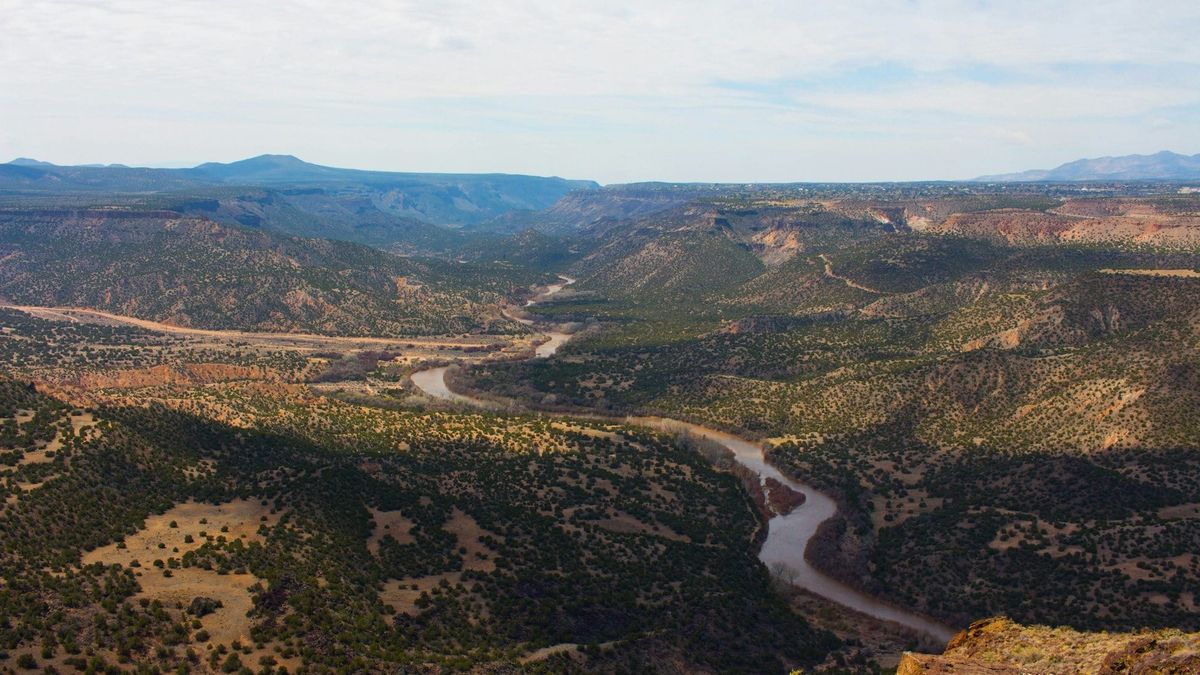
District officials say federal funding has not been specifically set aside for Rio Grande channel maintenance, leaving flood risks and costs to communities along the river
Damien Willis, Organ Mountain News
LAS CRUCES - Elephant Butte Irrigation District is pressing the federal government for $55 million to remove sediment and improve the Rio Grande channel, arguing that inadequate federal maintenance creates flood risks and shifts costs onto communities along the river.
EBID Treasurer-Manager Josh Smith told the district’s Board of Directors on Aug. 12 that he recently traveled to Washington, D.C., where he and regional water officials sought to have the money specifically set aside for Rio Grande work.
Smith said EBID coordinated with Hector Gonzalez of El Paso Water to arrange meetings with representatives at the White House, New Mexico’s congressional delegation, Senate appropriators and other congressional committees.
The problem, Smith said, is not simply a shortage of federal water money.
It is that money has not been specifically designated for the International Boundary and Water Commission to maintain the Rio Grande channel.
“We went to Washington, D.C., regarding the IBWC’s obligation to clean out the river channel,” Smith told the board.
EBID is asking for $55 million from roughly $301 million that Smith said has already been allocated to IBWC.
“What we were asking for was $55 million to be earmarked specifically for the Rio Grande,” Smith said.
The district believes the Washington trip may already have produced some movement.
Smith said the IBWC commissioner was required to submit a report to the Senate Appropriations Committee and included the Rio Grande channel issue in that report.
“So they’re planning on hopefully doing something,” Smith said.
 Damien Willis
Sediment is more than a maintenance problem
EBID’s Government Affairs Committee has framed sediment removal as a regional water and public-safety issue rather than simply routine river maintenance.
In a report to the board, the committee said its federal advocacy has focused on sediment accumulation, flood risk, impacts to regional water resources and costs borne by local entities when federal channel maintenance is not performed.
Sediment deposited in a river channel can reduce the amount of water the channel can carry and affect how water moves through the system.
For EBID, which operates the irrigation network serving farmers throughout the lower Rio Grande valley, the condition of the river also affects delivery and management of an increasingly scarce water supply.
The district has spent much of 2026 confronting that scarcity.
EBID ended irrigation deliveries in early July after entering the season with a four-inch allotment. Its water consultant, Dr. Phil King, told the board Aug. 12 to expect another “critically low” supply in 2027 as Elephant Butte and Caballo reservoirs remain near historic lows.
The channel-maintenance push adds another piece to that broader problem: Even as the region struggles with how much water is available, EBID says the physical condition of the river affects how that water can be moved and managed.
Support local journalism
Organ Mountain News provides independent reporting for southern New Mexico without a paywall. If you value this work, please consider supporting the newsroom with a one-time or monthly contribution.
Support Organ Mountain NewsA regional push
EBID is not pursuing the funding request alone.
The district has coordinated its advocacy with El Paso Water and previously provided IBWC project priorities to Texas Rio Grande Compact Commissioner Bobby Skov.
EBID officials said in July that IBWC staff had contacted the district about potential next steps after receiving those priorities.
The district’s Government Affairs Committee has also been preparing for additional state and federal advocacy as drought, Rio Grande management and water infrastructure take on greater urgency across southern New Mexico.
Smith characterized the Washington trip as productive.
“We did meet with the White House,” he said. “We met with all of our congressional delegation, at least their staffers.”
But whether that translates into money remains uncertain.
Smith cautioned that congressional budget decisions could still derail the request. If Congress relies on a continuing resolution that carries forward previous spending levels rather than approving a new budget containing the requested funding, he said, the district’s efforts could be delayed.
“All in all, I think it was a pretty successful trip,” Smith said.
For EBID, however, success ultimately depends on whether some of the federal money already headed to IBWC reaches the Rio Grande itself.
The district’s request amounts to roughly one-sixth of the $301 million Smith said is available to the federal agency.
EBID wants $55 million of it reserved for a problem district officials say will not disappear simply because the river is running low: keeping the Rio Grande channel capable of carrying the water — and flood flows — that eventually come through it.
Damien Willis is founder and editor of Organ Mountain News. If you have a personal story to share or a lead we should follow up on, reach out at OrganMountainNews@gmail.com or connect with him on X at @damienwillis.
Keep Reading
Las Cruces moves toward bringing back automated traffic cameras — Las Cruces officials are moving toward a new automated traffic-enforcement program, but key questions about locations, speeding thresholds and privacy rules remain unresolved.
Court records: Las Cruces teen accused of opening fire after alleged drug-sale encounter — Court filings detail an Aug. 21 shooting near Idaho Avenue and Luna Street that left one man wounded and led prosecutors to seek pretrial detention.
NMSU faculty leaders say spouse-employment problem hurts hiring, retention — Faculty Senate leaders say dual-career issues can make it harder to recruit and retain faculty and want a systemwide task force to study possible solutions.