Mescalero Apache teens are building wildfire and flood sensors to protect their community
Mescalero Apache students are developing wildfire and flood sensors aimed at giving their community earlier warnings as climate-driven disasters intensify.
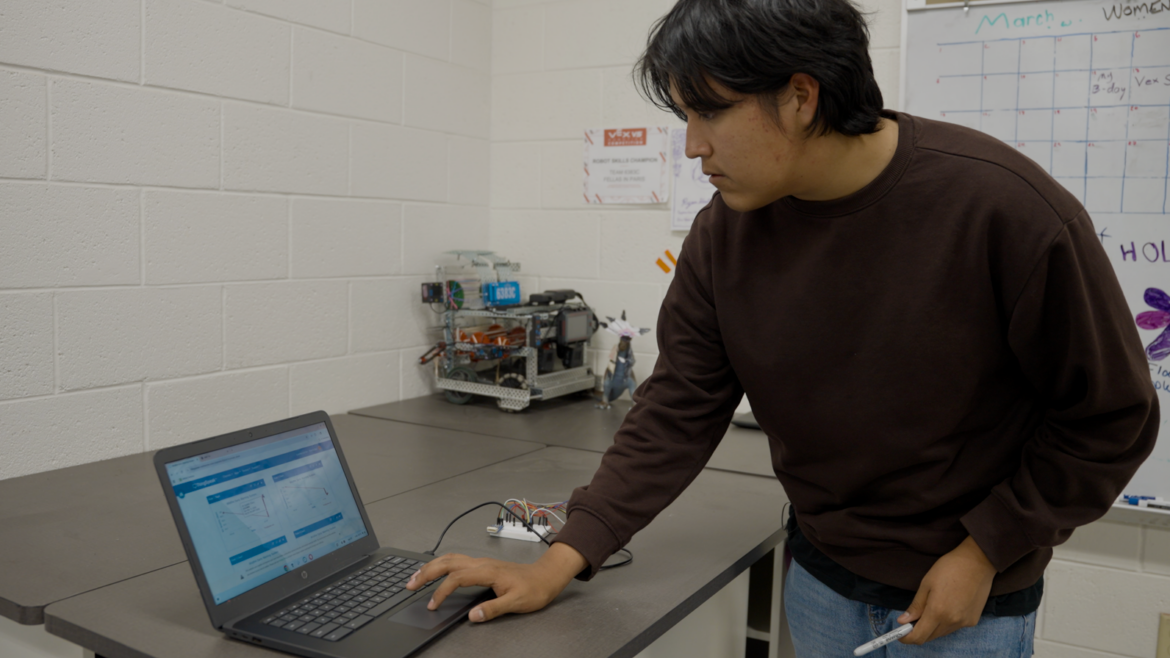
Students design low-cost early warning systems to detect smoke and rising water levels in fire- and flood-prone areas
Bella Davis, New Mexico In Depth
This is the latest story from Indigenously Positive, a collaborative series by New Mexico In Depth and NMPBS. Both newsrooms are participants in the Indigenous Climate Solutions Cohort, part of the Indigenous Journalists Association and Solutions Journalism Network’s Climate Beacon Newsroom Initiative.
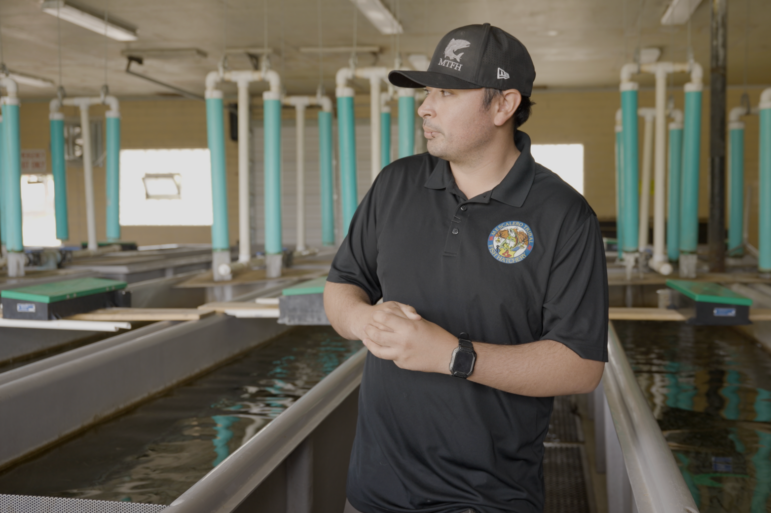
When the floodwaters came surging over an old burn scar in South Tularosa Canyon last July, John Salazar knew there was nothing he could do for the thousands of rainbow trout he’d raised from eggs.
He and the rest of the Mescalero Apache Tribe’s fish hatchery staff had about half an hour to evacuate after they got the warning. Minutes later, the flood hit, sweeping scores of fish down the road. Others perished as mud and debris built up in the tanks and the pipes, leaving them without the dissolved oxygen they needed to survive.
All told, half a million trout died — 95% of the fish the hatchery was raising.
“Being here for 11 years, it’s nothing that I’ve quite seen before,” said Salazar, a tribal member and the hatchery’s supervisor. Because it takes about 18 months to raise the trout before they’re released around the Southwest for recreation, recovery has been slow. “It took a toll on us, because all our progress was just completely lost in a couple hours.”
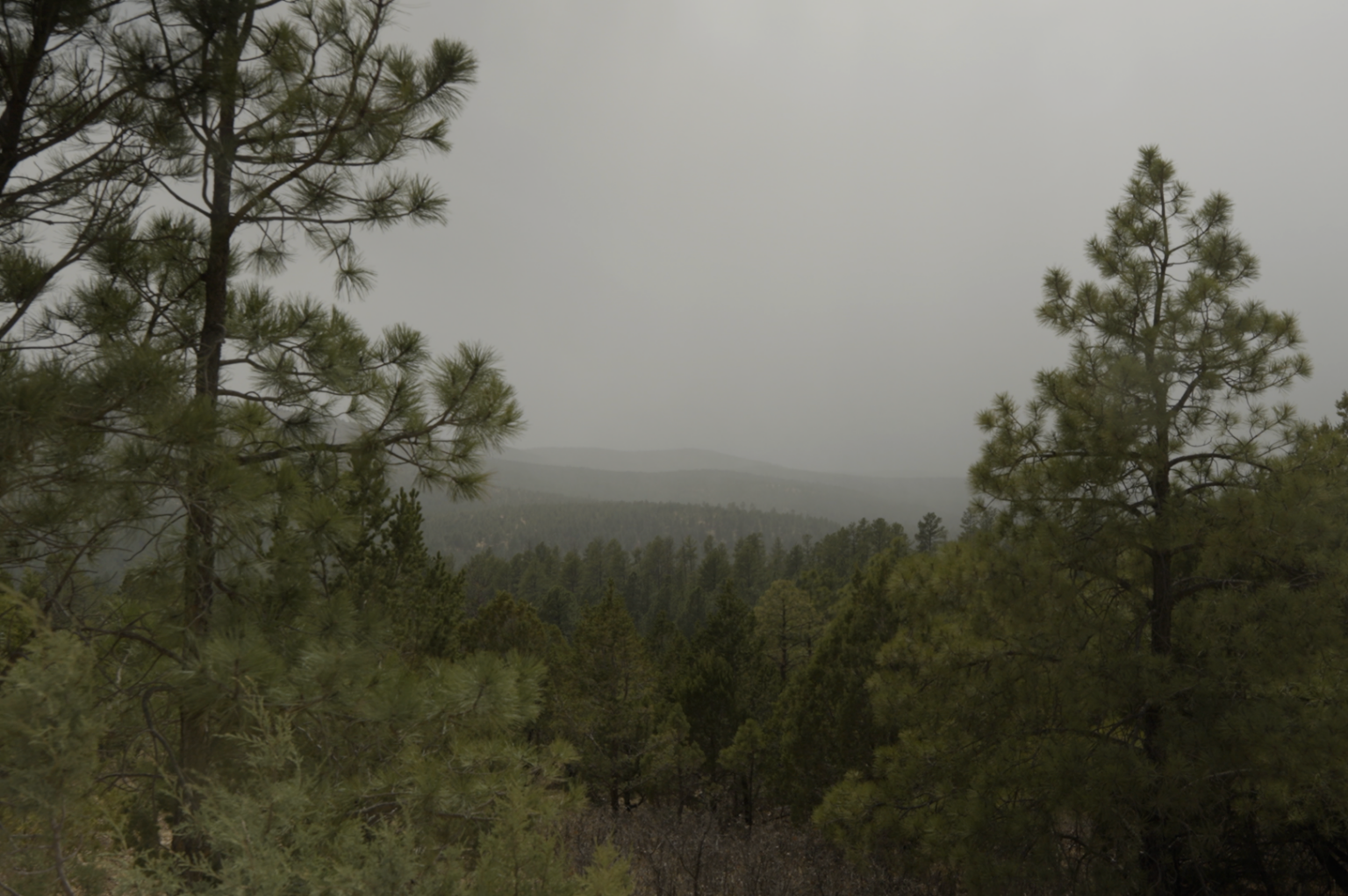
That’s just one of the ways in which the area has been affected by wildfires and subsequent flooding in recent years. Future projections are grim. Research has shown human-caused climate change is leading to increasingly frequent and intense wildfire activity.
New Mexico’s risk is higher than 82% of states, according to the U.S. Forest Service, and Mescalero has been identified as one of the most vulnerable places.
“I know that for me, it’s kind of devastating to see, especially knowing that it might get worse,” said Cody Rice, a high schooler in his junior year.
A school project got him thinking about how he might be able to help. He’s part of a four-student team developing wildfire and flood warning sensors they hope will one day be used to protect their southern New Mexico community.
For Rice, it’s about doing “something now before it gets a little too late.”
A week before the hatchery was hit, another flood in nearby Ruidoso killed two children and a 64-year-old man.
Wildfires in prior years — two of which, in 2024, were deadly — set the stage for the flooding. By burning away vegetation, fires leave soil loose and unable to absorb extra moisture.
“So when you get any amount of rain, even a half inch of rain we’ve seen this past couple years, it runs down the slopes and accelerates really fast,” said East Padilla, a tribal member who works for the tribe’s Division of Resource Management and Protection.
Part of what’s led to his community being threatened by wildfires, he said, is the federal government’s former policy, instituted nationwide in the early 1900s, of suppressing wildfires. Cultural burning — long practiced by Indigenous peoples globally for a variety of reasons — was also banned.
“This is kind of a fire regime area,” Padilla said. “The fires would happen every four to 10 years consistently. And now that humans kind of impacted that, our fire regime is not what it used to be, so it’s at greater risk that the forest does get unhealthy.”
Preventing small, natural fires results in fuel like dead branches building up and trees growing too closely together. In competing for resources, the trees are weakened and become more susceptible to wildfires. To try to manage that, the tribe employs thinning — strategically cutting down certain trees to increase the overall health of the forest.
As they got started on their project, the students wanted to know: How are wildfires on their reservation currently detected? Audrina Reynolds, a sophomore on the team, interviewed another staff member in the resource management division to get an answer: satellites, which are meant to locate hotspots.
They’re useful tools, Padilla said, but they sometimes issue false alarms. And they tend to be slow, sending alerts up to an hour after a fire starts.
In February, the students made the three-and-a-half-hour journey from Mescalero to Las Vegas to showcase their fire sensor at the New Mexico Governor’s STEM Challenge. It’s a statewide, annual competition for high schoolers that’s meant, in part, to connect them with potential future employers.
“It’s about getting out there and learning how to compete with people that don’t look like you,” said Nate Raynor, Mescalero Apache School’s STEM director. “And we’ve had some bad situations in some places when we went and being the only Indigenous school, and you can see it sometimes. But we overcame it.”
Raynor “really incentivizes us to do our best and really get into the STEM spirit because it’s important we show everyone else that we’re still here as Indigenous people,” Hendrick Aldava, a junior, said. Native people are underrepresented in the science, technology, engineering, and math workforce, although there’s been some improvement over the past decade, according to a 2023 report by the National Science Foundation.
This year, the competition asked students to think about how innovations can help their communities prevent natural disasters, mitigate harm, or recover.

With judges gathered around them, Rice gave a demonstration.
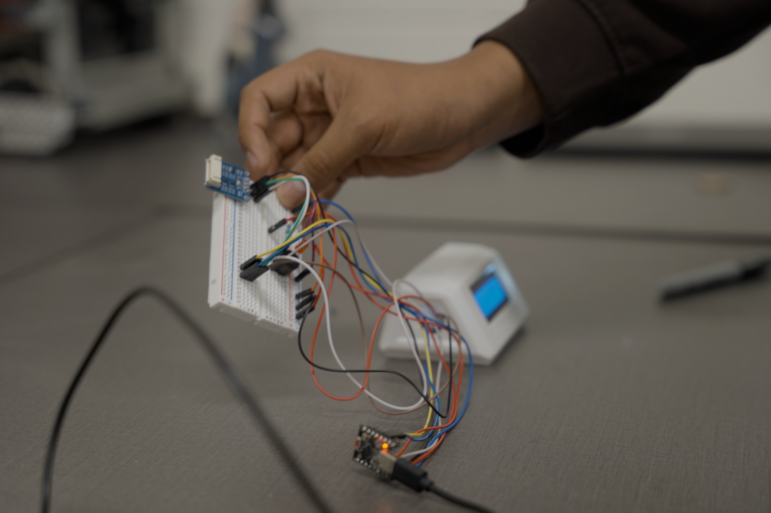
“Take something potent like a Sharpie, you know it has that smell?” he said, holding the marker near the sensor, causing it to start beeping. “The sensor will pick up those readings from the detection and it will give off an indication that there’s hazardous particles in the air.”
The sensor is designed to detect certain chemical compounds, like carbon dioxide. A small processor it’s hooked up to compares the readings to normal conditions to determine if a fire is likely burning. If it is, the system can send alerts to emergency services.
Research has found these kinds of sensors are promising for combating wildfires.
The Science and Technology Directorate, the research arm of the Department of Homeland Security, says it began that work in 2019, writing in a post on its website: “Available fire sensors at the time were optical cameras or thermal imaging — they would ‘see’ the fires. But have you ever known there was a fire nearby, whether a campfire or a grill or brush, because you could smell the smoke before you saw flames? That’s what our sensors program is aiming to do — ‘sniff’ out the fires as soon as they start, providing 24-hour sensing and alerting capabilities.”
A sensor installed in a Colorado forest in 2023 identified a flare-up at a controlled burn site and alerted the fire department, giving them a 37-minute head start before the first 911 call came in, according to the research division.
While they didn’t win an award at the challenge, the students say they plan to stick with their idea.
“This is just a prototype year,” Raynor said. “When he graduates, what I want to do is, Cody will be a senior, so his job next year is to find the underclassmen to take that project over.”
One improvement the students are working on is the fire sensor’s code, Rice said. He’s tinkering with it to narrow down which chemical compounds it responds to.
When they started developing the fire sensor, Rice said, they researched what was already on the market and found some sensors that likely would’ve been easier to program for their purposes. But they were several hundred dollars more expensive than what they ended up buying. Because they hope the warning system will actually be used one day, they’re trying to keep the costs down, Rice said.
The students are also trying to develop a flood sensor, which would be placed in a river and programmed to send out a warning if the water reached an abnormal height.
As with the fire sensor, coding — writing instructions that tell the processor how to read data from the sensor and interpret what it means — has emerged as the biggest challenge. The program flags that something is wrong but doesn’t point to what exactly the mistake is or how to fix it, said Anavay Wheeler, a junior.
“There’s so many limitations and then also just being a child and a girl, people underestimate you and maybe don’t listen to you and it’s really frustrating because I think this could have a huge impact,” Reynolds, the sophomore, said. But the possibility of helping her community “was so much more important than all of that,” she said, and has kept her going.
After more testing, they hope to present both sensors to the tribal council and potentially get funding, she said.
“I know some students, they probably think that they can’t do anything or it’s out of their reach, especially with new technology,” Rice said. “But I think learning to adapt to that change and having that motivation that it’s your tribe, it’s your land, you know, that you should do something about it.”
Bella Davis is an Indigenous affairs reporter for New Mexico In Depth, focused on issues including education and the missing and murdered Indigenous women and relatives crisis.
Las Cruces bondsman charged in alleged sex trafficking, forced labor scheme — A Las Cruces bondsman accused of exploiting people he bonded out of jail now faces federal charges that could carry life in prison; court records show he previously worked in the Doña Ana County Clerk’s Office and had publicly stated an intent to run for clerk.
State seeks to hold Las Cruces teacher in custody as court fight delays detention hearing — Prosecutors are pushing to keep the defendant jailed as a legal dispute delays the pretrial detention hearing.
NM Ethics Commission lawsuit targets Project Jupiter ad group — State regulators have filed suit over campaign finance disclosures tied to the high-profile development effort.