Aridification is here
Laura Paskus writes that New Mexico is already living with aridification as rivers dry, reservoirs shrink, trees die and communities face worsening water stress.
The changed climate is inevitable — suffering doesn’t have to be
Laura Paskus, Source New Mexico
Opinion
Editor’s note: The views expressed in this commentary are those of the author and do not necessarily reflect the views of Organ Mountain News.
This article was originally published by Source New Mexico.
Last week, more than 100 miles of the Middle Rio Grande were dry, as were roughly another 120 miles of the river in southern New Mexico, through Hatch, Las Cruces and Mesilla.
In Farmington, the Animas River should be running around 300 cubic feet per second. Instead, it’s below 30 cfs. The Santa Fe River above the city’s reservoirs is barely trickling. The Canadian River near Tyler Springs is tapped out, and so are numerous creeks that normally flow into the Cimarron River.
Most of New Mexico’s lakes and reservoirs are showing more shore than water, and some of the most popular are even off-limits to swimmers due to outbreaks of blue-green algae in the low, warm waters.
In Albuquerque and beyond, thousands of trees have dropped their leaves and are dying. (Even if you’re not inclined toward arboreal compassion, consider those trees falling onto roads, roofs and powerlines in the coming months.) In the Sandias, wildflowers have withered, and swaths of the forests are quiet of both bird song and insect buzz. And while this summer’s fires haven’t been as terrifying as those in 2022, more than 600 firefighters are currently battling the Frijoles Fire, which has threatened Cundiyó and continues bellowing unhealthy smoke into the skies.
Throughout the Middle Rio Grande Valley, farm fields are barren and orchards are dead, except where people have the rights or the resources to pump groundwater. In southern New Mexico, the Elephant Butte Irrigation District’s season ran for just over a month this year. And the people whose farms are surviving are pumping groundwater, a practice that landed New Mexico in a U.S. Supreme Court battle.
Meanwhile, bears are on the move, desperate for food and water, and they’re being hit by cars, relocated and shot. More elusive species like mountain lions and bobcats are suffering, too. If you’ve been paying attention, you’ve seen the carcasses of beavers and porcupines crossing roads in search of water. Skinny elk and deer are coming down from the high country.
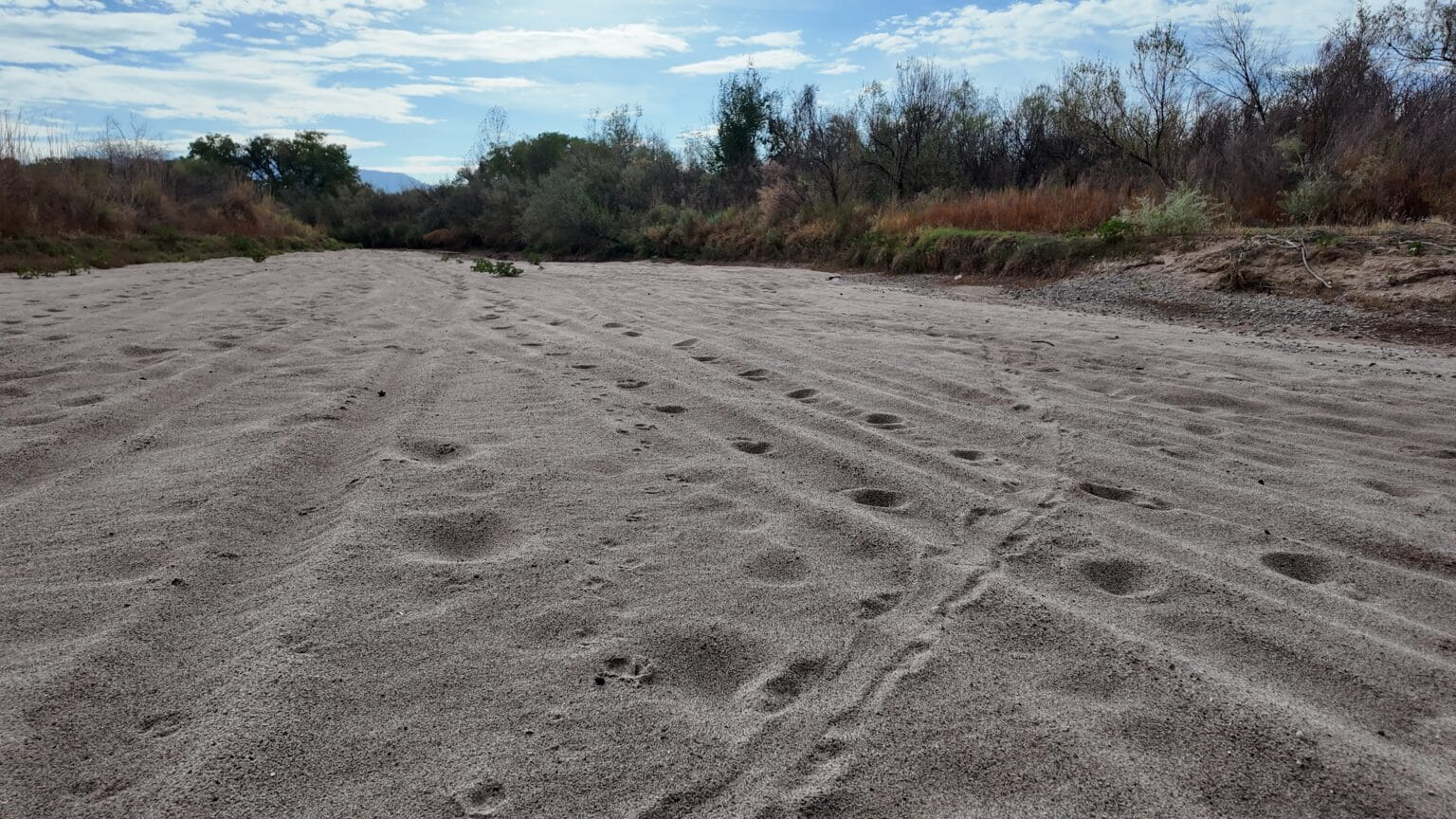
And when migrating sandhill cranes, snow geese and ducks start arriving next month, they won’t find food in the refuges or farm fields — or water in the Rio Grande. In fact, the river through Albuquerque will remain dry or nearly dry at least until November.
For decades, scientists warned that the U.S. Southwest would aridify as the climate continued warming. This summer, New Mexicans learned exactly what that means. And it’s just the beginning.
According to the American Meteorological Society’s 36th annual State of the Climate report, the last 11 years have been the warmest on record — and as almost anyone on the globe can attest, 2026 is serving up to be another record hot year.
In 2018, the Intergovernmental Panel on Climate Change warned that to avert “long-lasting” and “irreversible” changes, human-caused emissions of carbon dioxide “would need to fall by about 45% from 2010 levels by 2030, reaching ‘net zero’ around 2050.”
Yet, as the American Meteorological Society’s report shows, in 2025, the Earth’s greenhouse gas concentrations were the highest on record, with levels of carbon dioxide, methane and nitrous oxide all reaching new extremes last year. And 2026 is on track to be another banner year, for oil industry profits and greenhouse gas emissions.
It didn’t have to be this way.
More than 20 years ago, in October 2005, climate scientists like David Gutzler and Gregg Garfin spoke at the third annual Drought Summit in Albuquerque. Like many others, they connected the dots between rising greenhouse gas emissions and climate impacts to the U.S. Southwest. At that summit, the University of Arizona’s Kathy Jacobs warned land and water managers and public officials: “Don’t set communities up for devastating failure.”
Yet, many land and water managers, politicians and lawmakers, business and civic leaders, shareholders, realtors and others did just that, ignoring the advice and repeated warnings of scientists like Gutzler, who spent decades in his role as a professor at the University of New Mexico speaking to lawmakers, public officials, and reporters about the impacts of climate change.
Rather than feeling hopeless, however, New Mexicans must truly face the realities of rising temperatures and increased aridity.
It should go without saying that no candidate should be elected to office without honest commitments to climate mitigation and adaptation, and no voter should rest from holding those people accountable during their times in office.
But each of us also needs to make savvy daily choices, deciding which tree to keep watering and which garden to let die, deciding if it’s smart to pour herbicides onto a dying lawn or blast last-resort bird habitat in the neighborhood with a leaf blower. We need to decide if it’s safe for kids to attend school and play sports during dangerous heat waves, and we need to protect people who work and live outside. We must decide how we organize our public spaces and heat or cool our homes, how to help our neighbors and how to wrest control of our state — and the climate — from the fossil fuel industry.
We also need to reconsider how we treat wildlife bearing the brunt of human-caused climate change and immediately prioritize protection of our landscapes, rivers and groundwater supplies from overuse and pollution.
A changed climate is inevitable. Suffering doesn’t need to be. But it’s going to take each of us, paying attention, learning and adapting, accepting realities — and refusing to give up on the future.
Laura Paskus is an award-winning New Mexico environmental journalist who doesn't just report on climate change — she documents the state's active aridification from the frontline down to the dry beds of the Rio Grande.
Community Voices
Want to share your perspective? Organ Mountain News welcomes community voices on the issues that matter in Las Cruces and Doña Ana County. Send commentary submissions to OrganMountainNews@gmail.com.
Keep Reading
LCPS pays $11.3M for annual insurance coverage, up 14% from last year — District officials say rising property, liability and workers’ compensation costs are driving the increase.
Sunland Park voters to decide $8.25M bond package in November — Three ballot questions would fund recreation, public safety, roads and water and wastewater projects.
State Supreme Court asked to table Project Jupiter air quality permit process — New Energy Economy is asking justices to halt the proceeding before a Sept. 14 hearing, alleging due-process violations.