Latino families report rising costs, thin savings and immigration fears in new survey
The 2026 National Latino Family Report found Latino families with young children are facing rising costs, thin savings, food insecurity and immigration fears, with several New Mexico-specific findings.

The 2026 National Latino Family Report points to New Mexico as a policy model while finding families are strained by food, housing, health care, child care and deportation concerns.
Damien Willis, Organ Mountain News
LAS CRUCES - A new national survey of Latino parents with young children found families are losing financial ground as costs rise, savings shrink and immigration fears reshape daily life.
The 2026 National Latino Family Report, released by Abriendo Puertas/Opening Doors, UnidosUS and BSP Research, surveyed 1,300 Latino parents and primary caregivers of children from prenatal age through 5 years old. The poll, conducted March 9-April 17, included oversamples in New Mexico, California, Texas and Florida.
The report found that 49 percent of Latino parents surveyed said their financial situation had gotten worse over the past year, up from 36 percent in 2022. Only 21 percent said their situation had improved, down from 35 percent in 2022.
At the same time, 54 percent of Latino families surveyed reported having less than $1,000 in savings, including 18 percent with less than $100. Among Latina mothers, 60 percent had less than $1,000 in savings. Among parents ages 18 to 29, the figure was 64 percent.
The report also found that many families are worried about food. Nineteen percent of respondents said it was often true in the past year that they worried food would run out before they had money to buy more, while 39 percent said that was sometimes true. Thirty-nine percent said it was never a concern.

The financial pressure has forced families to make difficult choices, according to the report. Forty percent said they borrowed money from friends or family to manage rising costs. Twenty-nine percent put expenses on a credit card and paid them off over time, 23 percent sold something, 21 percent used up all or most of their savings and 16 percent applied for or received a loan from a bank or credit union.
Some families also reported skipping payments, moving in with others to reduce costs or cutting back on health-related expenses.
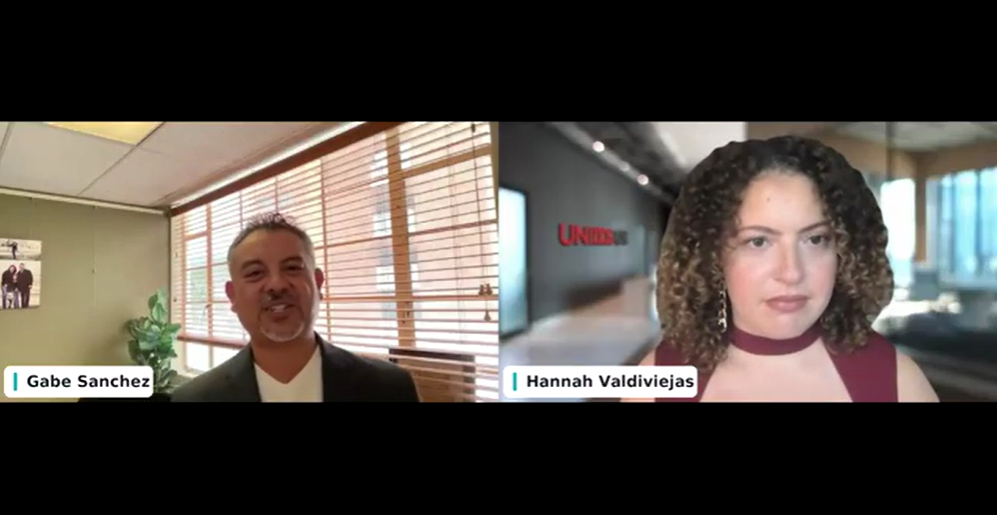
Gabriel Sanchez, director of research at BSP Research, said during a May 28 webinar that the annual survey is designed to provide “fresh data” about Latino families with young children.
“This is a rigorous sample design,” Sanchez said during the webinar. “It’s not done over social media only or done in a simple format.”
The survey was conducted online and by phone, in English and Spanish, and weighted to match U.S. Census estimates for Latino families with young children, according to the report.

New Mexico findings
New Mexico stood out in several parts of the report, especially on public benefits, health care, bilingual education and immigration enforcement.
New Mexico respondents reported the highest rate of applying for SNAP food assistance among the states highlighted in the report, at 47 percent, compared with 35 percent in Texas and 29 percent in California. New Mexico respondents also reported higher Medicaid application rates, at 36 percent, compared with 34 percent in Texas and 20 percent in California.
The report said New Mexico also stood out for higher reported applications for child care subsidies and unemployment benefits, each at 16 percent.
Those benefits were important to families who received them, according to the national findings. Forty-nine percent said social support benefits helped during a tough financial period, 42 percent said they helped while between jobs and 29 percent said assistance helped a parent stay home with children.
But 44 percent of families that applied for public benefits said they faced challenges gaining access to the program they applied for, including being told they were not eligible.

New Mexico House Speaker Javier Martínez, AP-OD’s managing director of national policy, opened the webinar by pointing to New Mexico’s recent child care and college affordability policies as examples of family-centered policymaking.
Martínez, who spoke in his AP-OD role, said New Mexico is “working hard to put children and families first.”
“We’re the first state in the nation to offer free universal child care,” Martínez said. “We’re one of the first states in the nation to offer free college for our students. We are truly investing from cradle to career, but that didn’t happen by accident.”
Martínez said the work was led by families and community organizations over many years.
“This is truly a family-led movement here in New Mexico,” he said.

Health care, child care and language
The report found that health insurance did not fully cover many Latino families’ needs. Among insured respondents, 53 percent said their health insurance covered only some of their needs, while 47 percent said it covered all of their needs.
New Mexico respondents were more likely than the national sample to say their insurance covered only some needs, at 58 percent.
Health care costs were a near-universal concern. The report said 98 percent of Latino parents surveyed said it was important for Congress and the president to address health care costs. In New Mexico, support reached 100 percent.
Child care also ranked high among families’ concerns. When asked which issues Congress and the president should address to improve child well-being, 43 percent named access to quality, affordable child care and early learning as one of the two most important issues.
Ninety-seven percent of respondents said it was important for Congress and the president to expand access to quality, affordable child care and early learning programs, including 69 percent who said it was very important.
More than half of Latino parents surveyed — 51 percent — said their child had not received child care since birth, including having someone come to the home at least twice per week. Among those families, 32 percent said the primary reason was affordability.
The report also found strong support for bilingualism. Nationally, 73 percent of respondents said they wanted their children to read and write in both English and Spanish. In New Mexico, that figure was 82 percent, nine points higher than the national average.
The report said 12 percent of New Mexico parents named access to bilingual education programs as one of the top two child well-being issues Congress and the president should address.

Immigration fears shape daily life
Immigration reform and protecting immigrant rights ranked as the top issue Latino families wanted Congress and the president to address, according to the report.
Forty-two percent of respondents named immigration reform as a top issue in 2026, up from 23 percent in 2025 and 13 percent in 2023 and 2022. Jobs and the economy ranked second at 38 percent, followed by cost of living and inflation at 37 percent, housing costs and affordability at 25 percent, health care at 20 percent and border security at 15 percent.
Sanchez said during the webinar that immigration had overtaken even economic concerns among Latino parents and primary caregivers.
“In this year’s survey, Latino parents and primary caregivers think that it’s even more important to address immigration reform than the economy, which I think is a very powerful statement,” Sanchez said.
The report found that 23 percent of all respondents said a family member or close friend had been detained or deported in the past year. The rate was 25 percent in Texas, 24 percent in California and 14 percent in New Mexico.
The report describes New Mexico as a national leader in immigrant protections, citing state limits on cooperation with federal immigration enforcement, restrictions on civil immigration detention agreements, limits on use of public land for immigration detention and bans on 287(g) agreements that allow local law enforcement agencies to take on immigration enforcement duties.
Sanchez said during the webinar that New Mexico’s lower number suggests state policy can reduce harm.
“The fact that you see almost a 10 percent lower number in New Mexico, I think sheds light on all the important work folks are doing in the state of New Mexico to address this issue,” Sanchez said.
But the report also found that fear of immigration enforcement affects families’ routines. Thirty-five percent of respondents said they may consider avoiding taking their children to school if they hear about ICE nearby. Twenty-four percent said they may avoid talking to police or reporting crime, 21 percent said they may avoid signing up for public benefits for themselves or their children and 16 percent said they may avoid visiting a doctor or clinic.
Joana Perez, a mother of eight who spoke during the webinar, said the data reflected what she has seen in her family and community in Los Angeles.
Perez said fear of ICE has brought “uncertainty,” “fear” and “anxiety” for families. She described parents leaving a school culmination ceremony because ICE was present nearby and said some families are afraid to apply for benefits because they worry their information will be in a government system.
Perez said Head Start and Early Head Start helped her family start a business because her younger children had access to child care.
“If we didn’t have Early Head Start and Head Start programs, we probably wouldn’t have been able to start our business this year,” Perez said.
Hannah Valdiviejas Cohn, an early childhood education policy analyst at UnidosUS, said during the webinar that immigration policy should be understood as more than an immigration issue.
“It is an early childhood issue, and it is a family economic security issue,” Valdiviejas Cohn said. “And overall, it’s a child well-being issue.”
Housing pressures
The report also found widespread concern over housing costs.
Seventy percent of respondents said they were worried they would not be able to afford to live in their current community because of rising housing costs, including 22 percent who said they were very worried.
Seventy-one percent said their rent or mortgage had increased over the past year. Among renters, 57 percent said not having enough savings for a down payment had kept them from buying a home, while 32 percent cited an inability to pay monthly mortgage payments and 25 percent said it was too hard or confusing to figure out how to buy a home.
The report concludes that Latino parents and caregivers of young children are facing a difficult economic and policy climate shaped by rising costs, health care barriers, unstable housing, child care needs and immigration enforcement concerns.

At the same time, the report found broad support for federal action across issue areas. Ninety-six percent of respondents said Congress and the president should address the cost of household items, including groceries, while 97 percent said they should focus on creating jobs that pay living wages with benefits.
Martínez closed the webinar by urging advocates and families not to lose hope.
“This is cyclical,” Martínez said. “We’ve seen this movie before. In my 20 years of organizing, I’ve seen this movie at least two or three different times. The last thing we could do is lose our hope.”
Damien Willis is founder and editor of Organ Mountain News. If you have a personal story to share or a lead we should follow up on, reach out at OrganMountainNews@gmail.com or connect with him on X at @damienwillis.
Keep Reading
New Mexico reports first New World screwworm case in Lea County dog — State and federal officials are investigating whether the pest was contracted in New Mexico.
Vado man gets life in federal prison for carjacking murder of Las Cruces man — A federal case tied to the 2023 killing of Abel Patrick Tarin ended with a life sentence.
Three New Mexico men charged in elk tag fraud scheme — Prosecutors allege resident elk tags were fraudulently obtained and transferred to out-of-state hunters.